Guitar Technique Tip
Dedillo A One-Finger Plucking Technique from the 16th Century
Learn how to execute this strange and little-known technique on the modern classical guitar.
Dedillo Right-Hand Technique in Classical Guitar and Vihuela/Lute
Here is a Quick Summary of this Technique Tip (1–2 minute read)
SUMMARY: What is Dedillo?
Dedillo is a historical right-hand technique for plucked instruments—most famously the Renaissance Spanish vihuela and, by extension, the modern classical guitar—where a fast passage is executed with a single finger moving back and forth like a plectrum. Although the Spanish word dedillo literally means “little finger,” in this context it means “one-finger technique.” Typically, the index finger does both strokes:
- Inward stroke: a normal pluck with the index finger.
- Outward stroke: a return stroke using the back of the same finger’s nail.
The result is alternate “down–up” articulation on one finger, analogous to pick-style alternate picking.
Historical context
In 16th-century sources, dedillo is often contrasted with dos dedos (“two fingers”), meaning alternation of either thumb–index (p–i) or index–middle (i–m). Vihuelists and lutenists primarily used dedillo for quick descending scalar runs—often called redobles, divisions, or diminutions. There are occasional historical examples of an analogous thumb version on the basses (outward–inward strokes with the thumb), but that is the exception rather than the rule.
How it sounds and feels
- Dedillo produces a lighter tone than p–i alternation and much lighter than i–m alternation.
- It naturally yields a strong–weak pattern (the inward stroke tends to be stronger, the outward stroke lighter). This unequal articulation can be stylistically appropriate in early music.
- By contrast, i–m alternation tends to sound more even from note to note.
Historical repertoire
Dedillo is closely associated with Spanish vihuela repertoire (late 1400s–1500s). Composers include Luys Milán, Luys de Narváez, Alonso Mudarra, Enriquez de Valderrábano, Diego Pisador, and others.
It appears explicitly in Alonso Mudarra’s Tres Libros de Música en Cifras para Vihuela (1546), where some fast passages are marked “dedi,” indicating dedillo.
Mudarra advised using dedillo mainly for descending scales, and thumb–index alternation for ascending scales and cadential figures. On the lute elsewhere in Europe, the predominant approach was strict thumb–index alternation rather than dedillo.
Using dedillo on the modern classical guitar
While dedillo can be played effectively on a modern instrument, it is more demanding than standard two-finger alternation and is not the default for modern scale playing. Its best use-case today is historically informed performance of vihuela music.
In modern guitar repertoire, when dedillo appears, it is often repurposed as a mandolin-style tremolo on sustained notes or chords (rather than for fast scalar runs), and there is also a “pick-style” variant with the thumb locked against the index, treating the index like a plectrum.
Hand positions you can use
- Normal modern classical position: Keep the wrist relatively flat, with very small, efficient index motions. Alternate inward (normal) and outward (back of nail) strokes. Historically, starting with an inward stroke is typical. Tone is bright and clean; accuracy is good on the 1st string.
- Modified vihuela-style thumb-over (thumb-out): Arm set a bit below the bridge; the hand turns so the upper knuckles approach perpendicular to the strings. You can use a slightly more lateral, along-the-string swing, which can help avoid striking adjacent strings on inner-string passages. Produces a silky tone; accuracy on string crossings is good.
- Thumb-under (thumb-in) variant: Similar period hand logic, with the thumb tucked in. Some players mix positions (e.g., thumb-over for dedillo, thumb-under for p–i figures) depending on the passage.
- Modern “pick-style” dedillo: Lock the thumb against the index and use down–up strokes with the index as if holding a pick. Allow some hand/arm rotation. This can provide very clean attacks and good string-crossing accuracy.
Common challenges and solutions
- Hitting adjacent strings on inner strings (e.g., playing dedillo on the 2nd string and brushing the 1st): In the normal classical position, make the finger motions tiny and controlled. In the vihuela-style positions, use slightly longer, lateral strokes that travel more parallel to the string.
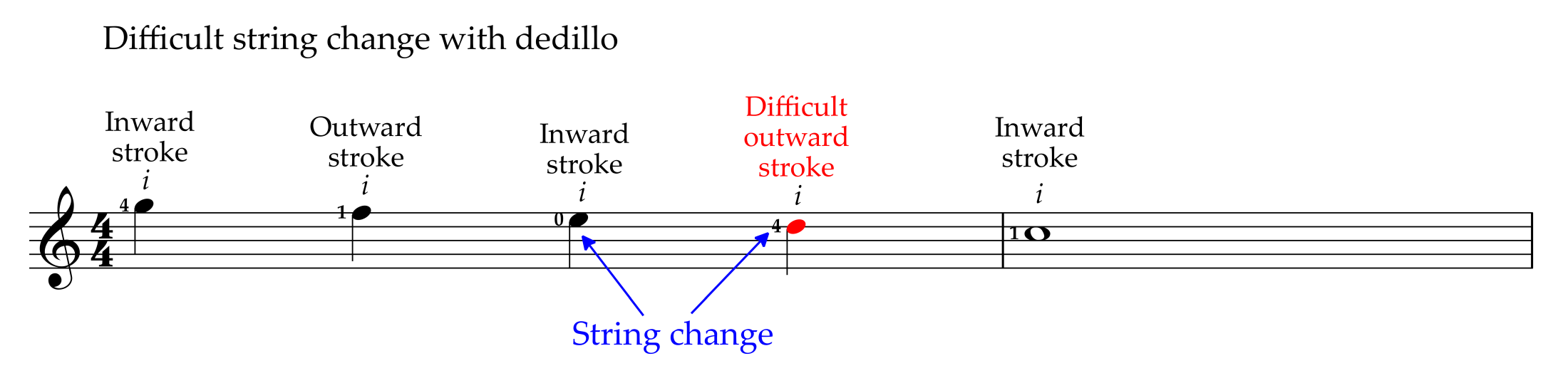
- String changes: Crossing from, say, the 1st to the 2nd string with an outward stroke is tricky. Accuracy improves with slow, patterned practice and careful hand alignment. A useful variant is inward rest stroke + outward free stroke, occasionally “dragging” the finger across to catch the next string cleanly at crossings.
- Accent balance: Expect the inward stroke to be naturally stronger. Embrace that for early music; if you need absolute evenness, i–m or p–i may be preferable.
Nails
If you play with nails, you don’t need to do anything special for dedillo. The inward stroke uses your usual flesh–nail contact; the outward stroke uses the back of the nail.
When dedillo is (and isn’t) the right tool
Good for:
- Historically informed vihuela passages (especially marked “dedi”) and short, descending scalar figures.
- In modern repertoire, it can be effective as a single-finger tremolo color on sustained notes or double-stops when requested by the composer.
Less ideal for:
- Long, multi-string scalar runs on the modern guitar, or any passage requiring very even tone and no strong–weak inequality.
- For those, thumb–index or index–middle alternation is usually cleaner and easier.
How to start practicing dedillo (open strings)
Single strings
- 1st string: Slowly alternate inward (normal) and outward (back-of-nail) strokes with the index. The 1st string is easiest because there’s no higher string to hit.
- 2nd string: Same alternation, now carefully avoiding the adjacent 1st string. Adjust hand angle as needed (tiny motions in modern position; more lateral strokes in vihuela-style positions).
- 3rd string: Repeat, avoiding the 2nd string.
String changes between 1st and 2nd strings
- Groups of four: Play four notes on the 1st string, then four on the 2nd. Do a set starting each group with an inward stroke, then another set starting with an outward stroke.
- Groups of two: Play two notes on the 1st string, then two on the 2nd. Again, practice starting with inward strokes and then with outward strokes.
Expect a learning curve.
Dedillo demands significant conditioning of the index finger and refined control of stroke size and hand angle. It is easier on the 1st string and becomes progressively more challenging as you move toward the inner strings and begin crossing strings at speed. These difficulties help explain why dedillo largely disappeared from mainstream classical guitar pedagogy as the repertoire moved away from Renaissance sources and toward techniques that favor evenness and reliability across many strings.
Bottom line
Dedillo is a specialized one-finger, back-and-forth plucking technique with distinct historical roots and a characteristic strong–weak articulation. On the modern classical guitar, it’s a valuable color and an authentic tool for vihuela transcriptions, but for general scale playing, most guitarists will achieve cleaner, more consistent results with thumb–index or index–middle alternation.
Note: This is only a summary of the full article below—read the full post for nuance, examples, and videos.
What "dedillo" means
Dedillo (Spanish: “little finger,” but in this context playing with one finger) is a historical right-hand technique where you play a fast scalar passage by moving the index finger back-and-forth across a string like a plectrum. In vihuela sources it’s often contrasted with dos dedos or “two fingers,” i.e., alternating two digits, either the thumb and index finger (p-i) or the index and middle fingers (i-m.
Think of it as alternate picking with one finger:
- Inward normal stroke with the index finger
- Outward stroke with the back of the fingernail of the same index finger
Vihuelists and lutenists used the dedillo technique to play mostly descending fast scales (aka redobles, divisions, or diminutions).
Occasionally, vihuelists used outward-inward strokes with the thumb to play fast scales or figures on the bass strings.
Wait—what is a vihuela?
A Renaissance vihuela is a Spanish plucked string instrument from roughly the late 1400s through the 1500s
- What it looks like: It has a guitar-shaped body with a flat back and a waisted outline—unlike the deep bowl-back of many lutes—though the waist is typically shallower and less pronounced than on a modern classical guitar.
- Strings: Typically 6 courses (that means pairs of strings, like a 12-string guitar concept—though the top course is sometimes single).
- Tuning: Very often like a Renaissance lute (in 4ths with one 3rd in the middle), so players could use similar fingering logic. For example, from highest-pitched to lowest-pitched string: E-B-F#-D-A-E.
- How it’s played: There were three variants: vihuela de mano plucked with the fingers, vihuela de arco played with a bow, and vihuela de péñola played with a plectrum. It used tablature (Spanish/Italian systems) rather than staff notation for most solo repertoire.
- What it was used for: It was a big deal in Spanish courtly music—lots of intricate polyphony, fantasias, diferencias (variations), intabulations of vocal works, etc.
- Key composers: You’ll see names like Luys Milán, Luys de Narváez, Alonso Mudarra, Enriquez de Valderrábano, Diego Pisador.
Where it shows up in 16th-century Spanish vihuela music
In Spanish vihuela practice, players used multiple right-hand options, including:
- dos dedos (two-finger alternation, such as p-i or i-m), and
- dedillo (single-index back-and-forth).
Vihuelists and guitarists can use (1) dedillo, (2) alternate the thumb and index fingers, or (3) alternate the index and middle fingers to play fast scale passages in the music of vihuelists such as Luys Milán, Luys Narváez, and Alonso Mudarra. The technique is particularly associated with Alonso Mudarra's Tres Libros de Música en Cifras para Vihuela (1546), where dedillo passages appear in several fantasias. Some passages are specifically marked “dedi”, indicating the player should execute the passage with the dedillo technique.
Dedillo differs fundamentally from the predominant Renaissance lute technique. On the lute, particularly with thumb-under positioning common across Europe, fast runs employed strict alternation of thumb and index finger (p-i technique), with both the thumb and index performing downward and upward strokes respectively.
How does it sound?
The dedillo technique produces a lighter sound than alternating p-i and much lighter than alternating i-m. Dedillo and p-i naturally produce a distinct strong-weak pattern while i-m alternation results in notes that are even in volume.
Listen to Yasunori Imamura play dedillo on the vihuela. He uses quite a bit of dedillo combined with thumb-index alternation. However, when he plays dedillo, he begins each passage with an inward stroke (counter to the prevailing historical style). He uses the thumb-over (thumb-out) hand position to play dedillo but the thumb-under (thumb-in) position to play thumb-index figures.
Ralph Maier gives a beautiful performance of “La Canción del Emperador “by Luys Narvaez on the vihuela using the dedillo technique. He uses the thumb-over (thumb-out) hand position. He even plays dedillo with the thumb!
Listen to Enrike Solinis demonstrate the dedillo on the lute. He uses the thumb-under (thumb-in) hand position. He also uses some rest stroke-free stroke combinations (described below):
How to play dedillo on the modern classical guitar
Hand positions
On the modern guitar, we can play dedillo using four different hand positions.
- The normal modern classical guitar hand position.
-
The historically correct thumb-over or thumb-out vihuela position where the player extends the thumb out to the left of the index finger.
- Place the arm below the bridge.
- Turn the hand so the upper knuckles are almost perpendicular to the strings.
- Plant the pinky on the soundboard.
- Keep the thumb out to the left of the index finger.
-
The historically correct thumb-under or thumb-in vihuela position where the player tucks the thumb into the hand.
- Place the arm below the bridge.
- Turn the hand so the upper knuckles are almost perpendicular to the strings.
- Plant the pinky on the soundboard.
- Tuck the thumb into the hand.
-
The hand position guitarists use when playing with a pick (plectrum).
- Place the arm in a normal position or slightly below the bridge.
- Turn the hand so that the upper knuckles are not parallel with the strings.
- Lean the hand a little to the right.
- Lock the thumb against the index finger.
- Optional: Rest the pinky on the soundboard if playing the first four strings.
In this article, I use the terms “thumb-under” and “thumb-in” interchangeably.
Likewise, I use the terms “thumb-over” and “thumb-out” interchangeably.
In the videos below, I will demonstrate the dedillo technique with this passage from the first “Pavana” in Luys Milán’s book, Libro de música de vihuela de mano intitulado El Maestro (1536).
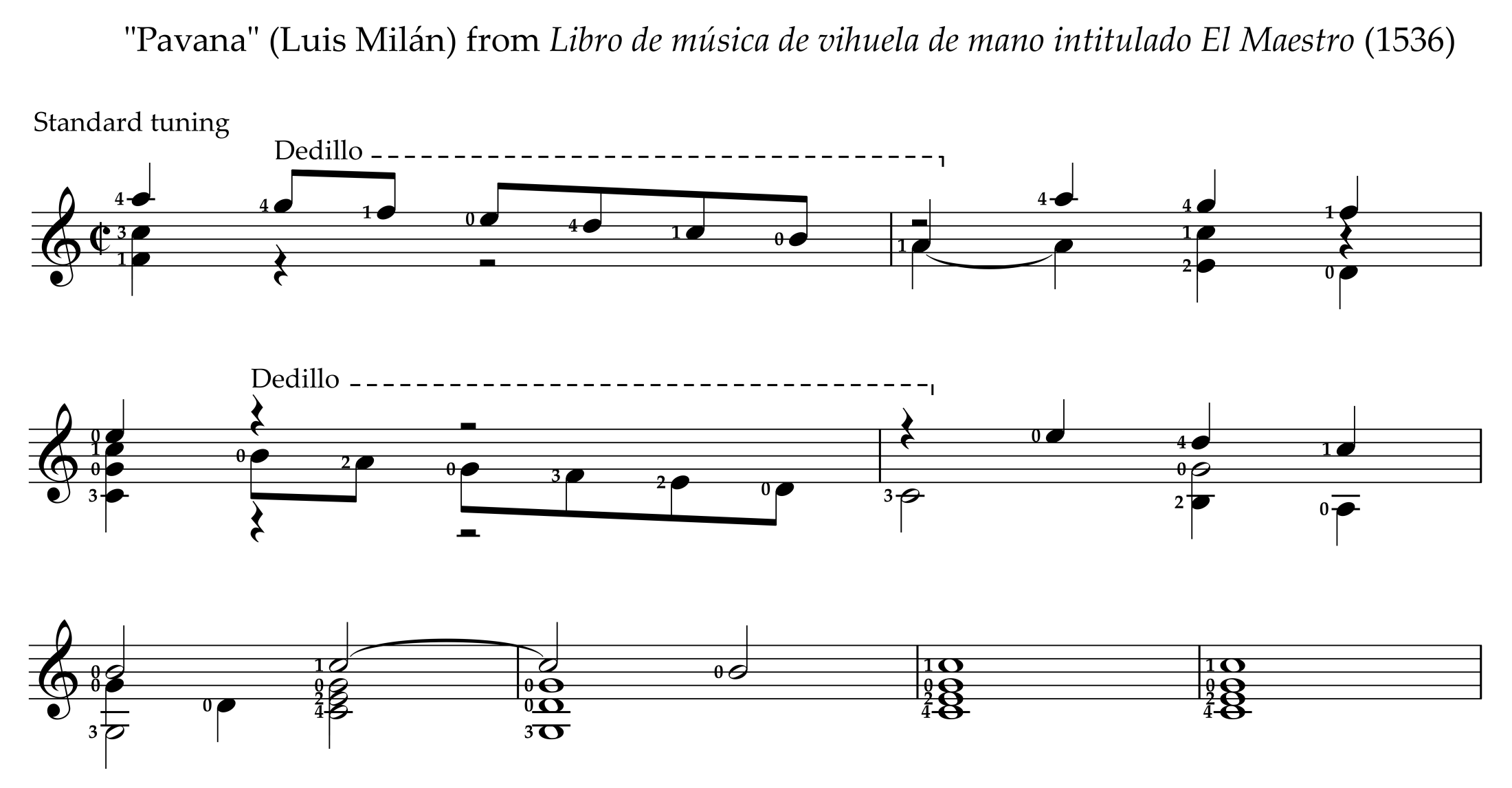
A. Dedillo using the normal classical guitar hand position
- Dedillo is easiest to learn on the 1st string.
-
Play alternating strokes with the index finger only:
- Inward: pluck the string normally with simultaneous flesh-nail contact
- Outward: pluck the string with the back of the fingernail
- In a conventional modern classical guitar right-hand position, the motion is tiny and efficient—mostly from the finger joints, not the whole hand.
- Keep the wrist flat and lean the hand back a bit.
- Optional: plant the little finger on the soundboard. Or, plant the “a” finger on the 1st string if playing the 2nd through 5th strings.
- Optional: Plant the thumb on a lower-pitched string.
- The first stroke should be an inward stroke. Alternate the inward-outward strokes.
- Expect a natural strong–weak feel (the inward stroke will be stronger). Musicologists believe that historically, unequal strong-weak articulation is stylistically appropriate in some early music contexts.
- Not recommended: Some players reverse the alternation using outward strokes for the strong beats and inward strokes for the weak beats.
B. Dedillo using a modified thumb-over (thumb-out) vihuela or lute-style hand position.
- Set the arm below the bridge.
- Place the little finger on the soundboard.
- Set the right hand so that the upper knuckles are almost perpendicular to the strings (instead of their normal parallel with the strings position).
- Set the thumb to the left (outside) of the index finger.
- Allow the wrist to sink. Do not attempt to keep it flat as in the conventional classical guitar position.
- Do not allow the hand to roll to the right.
- Optional: Plant the thumb on a lower-pitched string.
- Rather than playing across the string, make lateral strokes along the string, plucking almost parallel with the strings.
- The first stroke should be an inward stroke. Alternate the inward-outward movements and pluck the string with fairly long, pendulum-like swinging movements. Do not attempt to constrict the finger movements.
- Not recommended: Some players reverse the alternation using outward strokes for the strong beats and inward strokes for the weak beats.
C. Dedillo using a modified thumb-under (thumb-in) vihuela or lute-style hand position.
- Set the arm below the bridge.
- Place the little finger on the soundboard.
- Set the right hand so that the upper knuckles are almost perpendicular to the strings (instead of their normal parallel with the strings position).
- Tuck the thumb into the hand to the right of the index finger.
- Allow the wrist to sink. Do not attempt to keep it flat as in the conventional classical guitar position.
- Do not allow the hand to roll to the right.
- Optional: Plant the thumb on a lower-pitched string.
- Rather than playing across the string, make lateral strokes along the string, plucking almost parallel with the strings.
- The first stroke should be an inward stroke. Alternate the inward-outward movements and pluck the string with fairly long, pendulum-like swinging movements. Do not attempt to constrict the finger movements.
- Not recommended: Some players reverse the alternation using outward strokes for the strong beats and inward strokes for the weak beats.
D. Dedillo using rest strokes for the inward strokes and free strokes for the outward strokes. Use finger drags for string changes.
- Set the arm in its normal classical guitar position.
- Set the hand in a normal classical guitar hand position to play rest stroke, but lean the hand forward a little more than the normal rest stroke position. This forward position will make it easier to drag the finger across the strings to make string changes.
- Start with an inward REST STROKE with the index finger. Then an outward stroke with the back of the nail of the index finger. Repeat.
- If the index finger plays a rest stroke and the next note is on the next lower-pitched string, DRAG the index finger across the new string to play it rest stroke. For example, play the 1st string rest stroke, follow through onto the 2nd string, then play the 2nd string rest stroke.
- Optional but recommended: Plant the thumb on a bass string.
E. Dedillo using a modern-day pick (plectrum) position
- Set the arm in its normal classical guitar position or a little lower than the bridge.
- Place the hand so the upper knuckles are not parallel with the strings.
- Lock the right-hand thumb against the index finger.
- The wrist can be flat or can sink in.
- Play down-up (outward-inward) strokes with the index finger as if you are holding a pick, using free wrist movements and some arm rotation.
- Optional: Allow the little finger to rest or travel on the soundboard.
- When using this method, some players reverse the finger motions. As in modern pick playing, they use a downstroke (back of the fingernail) on the strong notes and an upstroke (inward stroke) on the weak notes.
Here is a handy table showing the different methods of playing dedillo on the modern classical guitar:
THE DEDILLO TECHNIQUE: |
|||||||||||
TYPE OF STROKE |
ARM POSITION |
HAND POSITION |
THUMB POSITION |
PINKY ON SOUNDBOARD? |
THUMB PLANTED? |
AMOUNT OF INDEX SWING |
WRIST POSITION |
LEAN HAND BACK? |
BEGIN WITH INWARD OR OUTWARD STROKE? |
TONE |
ACCURACY OF STRING CROSSES |
|---|---|---|---|---|---|---|---|---|---|---|---|
Dedillo, using the modern classical guitar hand and thumb position |
Normal |
Normal classical position |
Normal thumb-over (thumb-out) |
Optional: plant the little finger on the soundboard to play all strings. Or, plant the “a” finger on the 1st string if playing the 2nd through 5th strings. |
Not recommended for redobles (fast scales) covering many strings. |
Minimal |
Flat |
Yes |
Either, but inward is historically correct |
Brighter with clean attack |
Good |
Dedillo, thumb over (thumb-out). Used by Luys de Narváez, Diego Pisador, Miguel de Fuenllana, and Esteban Daza. |
Below bridge |
Knuckles almost perpendicular to strings |
Thumb-over (thumb-out) |
Yes |
Optional |
Pronounced, less as tempo increases |
Sinking is best for string crossing, but flat wrist works too. |
N/A |
Either, but inward is historically correct |
Very silky |
Good. Playing with lateral finger strokes along the string makes it easier to avoid accidentally striking adjacent strings. |
Dedillo, Thumb-under (thumb-in). Used by Luys Milán and Alonso Mudarra. |
Below bridge |
Knuckles almost perpendicular to strings |
Thumb under (tuck thumb into hand) |
Yes |
Optional |
Pronounced, less as tempo increases |
Sinking is best for string crossing, but flat wrist works too. |
N/A |
Either, but inward is historically correct |
Very silky |
Good. Playing with lateral finger strokes along the string makes it easier to avoid accidentally striking adjacent strings. |
Dedillo, rest stroke on inward stroke, free stroke on outward stroke. Use finger drags as needed for string crossings. |
Normal |
Normal classical position |
Normal thumb-over (thumb-out) |
No |
Recommended |
None |
Flat or sinking |
Lean the hand forward a little more than the normal rest stroke position to make finger dragging at string changes easier. |
Inward |
Fuller with pronounced strong/weak |
Good. Finger drags can be tricky. |
Dedillo, modern "pick-style". Lock thumb against index finger (only pluck with index finger), treating index finger as a plectrum. |
Normal to slightly below bridge |
Knuckles not parallel with strings. Hand leans slightly right. |
Locked against index finger |
Optional if playing first four strings |
N/A |
Hand and arm swing and rotate |
Sinking |
No |
Either. |
Bright with clean attacks |
Good to excellent |
CHOICES OTHER THAN DEDILLO: |
|||||||||||
TYPE OF STROKE |
ARM POSITION |
HAND POSITION |
THUMB POSITION |
PINKY ON SOUNDBOARD? |
THUMB PLANTED? |
AMOUNT OF INDEX SWING |
WRIST POSITION |
LEAN HAND BACK? |
BEGIN WITH INWARD OR OUTWARD STROKE? |
TONE |
ACCURACY OF STRING CROSSES |
Finger-finger alternation. Usually index-middle (i-m) or index-ring (i-a). |
Normal |
Normal classical position |
Normal thumb-over (thumb-out) |
No |
Either |
None |
Flat |
None for free stroke. Yes if rest stroke. |
All inward strokes |
Bright with clean attacks. Rest stroke strong and full. |
Good to excellent |
Historically correct thumb-index (p-i) alternation. Thumb-under (thumb-in) position |
Below bridge |
Knuckles almost perpendicular to strings |
Thumb under (tuck thumb into hand) |
Yes |
No |
Some to very little |
Sinking to flat |
N/A |
Begin with thumb outward then index inward. Can also reverse alternation in modern classical guitar technique. |
Pronounced strong/weak |
Good to excellent |
Historically correct thumb-index finger alternation (p-i). Thumb-over (thumb-out) position. |
Below bridge |
Knuckles almost perpendicular to strings |
Normal thumb-over (thumb-out) |
Yes |
No |
Some to very little |
Sinking to flat |
N/A |
Begin with thumb outward then index inward. Can also reverse alternation in modern classical guitar technique. |
Pronounced strong/weak |
Good to excellent |
Thumb-index finger alternation (p-i) adapted to modern classical guitar hand position. In modern classical guitar technique, some players use thumb-middle finger alternation (p-m). |
Normal |
Normal classical position |
Normal thumb-over (thumb-out) |
No |
No |
None |
Flat |
No |
Begin with thumb outward then index inward. Can also reverse alternation in modern classical guitar technique. |
Pronounced strong/weak |
Good to excellent |
This is not easy!
In preparing to write this article, I practiced the dedillo technique over several weeks. I found it difficult to execute on a modern classical guitar no matter which method I used. Although using it on just the 1st string was a little easier, it was really hard to do on the other strings.
Avoid hitting adjacent strings
One difficulty in playing dedillo on an inner string, is to avoid hitting the adjacent higher-pitched string. So, when I was playing the 2nd string, my finger would often hit or brush the 1st string. In method A (the normal classical guitar hand position), the solution was to use very small and controlled finger strokes. But I found I was more accurate with Method B or C (the modified vihuela hand positions) using longer, lateral, swinging strokes almost parallel with the string.
String changes
String changes are an additional problem. It is hard to hit the correct string at string changes. For example, starting on the 1st string and then having to change to the 2nd string with an outward stroke is very tricky. Not only do you have to hit the correct string, but you must do it without accidentally hitting the 1st string.
Which method should I use to play dedillo?
My recommendation is to try all of the methods to see which suits your playing style the best.
Remember, we use the dedillo mostly for descending scales. Vihuelist Alonso Mudarra (1510-1580) advised using dedillo for descending scales and thumb/index alternation (dos dedos– two fingers) for ascending scales and cadential ornamentation.
Note that if you use nails, no special accommodation is necessary to use them when playing the dedillo technique.
When dedillo is the right tool (and when it isn’t)
Great for:
- Fast descending scales/diminutions on a single string
- Fast descending scales/diminutions on multiple strings if there are not too many string changes
- Repeated notes (tremolo-like repetition, pick-like clarity)
- Passages where you want a pronounced strong-weak accentuation
Less ideal for:
- Lots of string crossing (two-finger alternation, either p-i or i-m is cleaner and easier)
- Passages where you want a very even tone color and unaccented strong-weak notes (dedillo is inherently unequal)
Therefore, although dedillo is intriguing and unusual, it is one option for playing scales (usually descending) in early music. Keep in mind that it is difficult to learn and use on a modern classical guitar. The technique demands significant finger conditioning compared to conventional alternation, which explains why it disappeared from pedagogical practice as the classical guitar repertoire shifted away from Renaissance sources. Although it is fun to play with historically-correct techniques, thumb-index and index-middle are viable and often preferable options for the modern guitarist.
However, for performers seeking historically-informed interpretation of Renaissance music, understanding dedillo's mechanics, sound quality, and documented use in period sources remains essential to authentic performance of vihuela repertoire.
How to practice to learn to play the dedillo technique
To start, use whichever hand position feels most comfortable. Later, you can try the other positions. Practice the exercises on the open strings.
Practice on single strings
1. Start by practicing inward/outward strokes very slowly on the 1st string. The 1st string is easiest since you don’t have to worry about accidentally hitting an adjacent higher-pitched string.
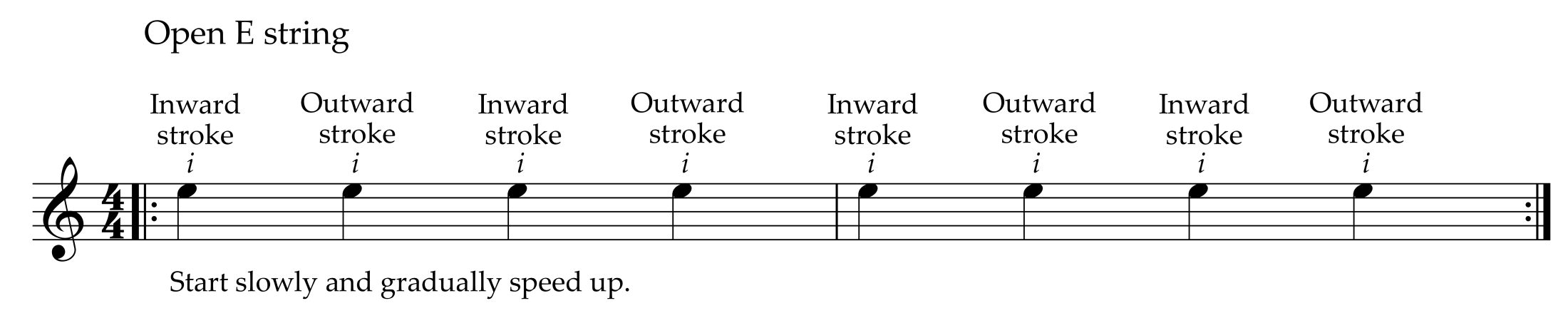
2. Try the dedillo on the 2nd string. Now it is more difficult because you have to be careful not to accidentally hit the adjacent 1st string.
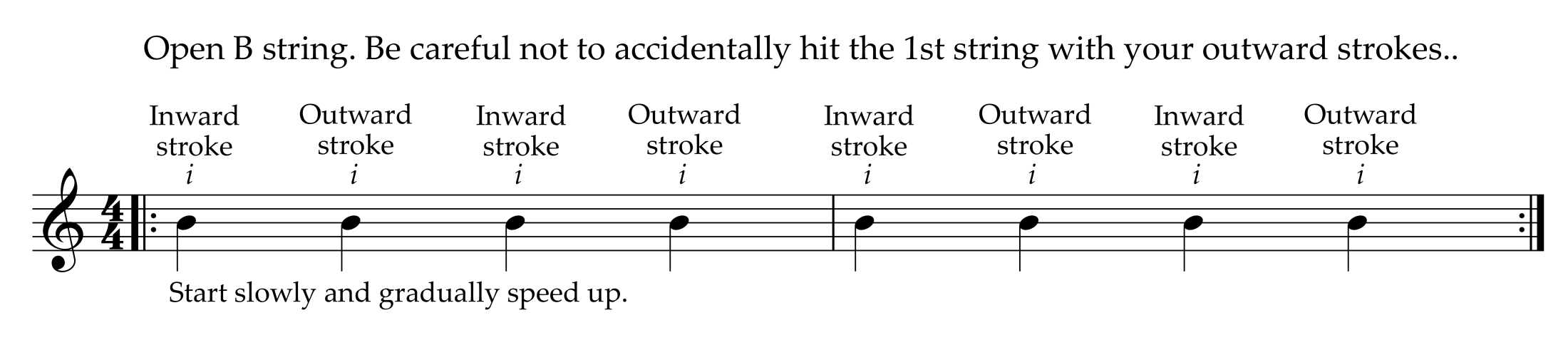
3. Finally, try the dedillo on the 3rd string being careful not to accidentally touch the 2nd string.
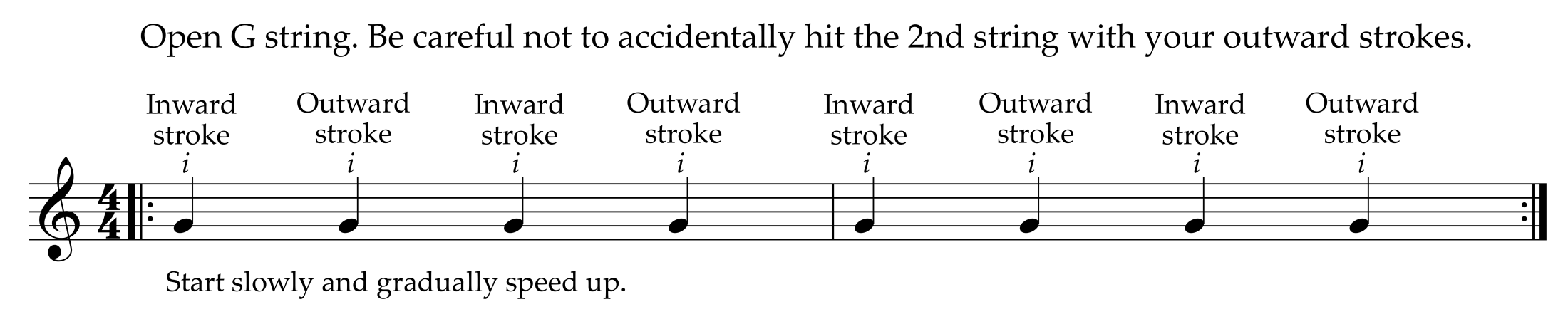
Practice string changes on the 1st and 2nd strings
1. Practice groups of four notes
- Play four notes on the 1st string and then four notes on the 2nd string. Start each group of four notes with an inward stroke.
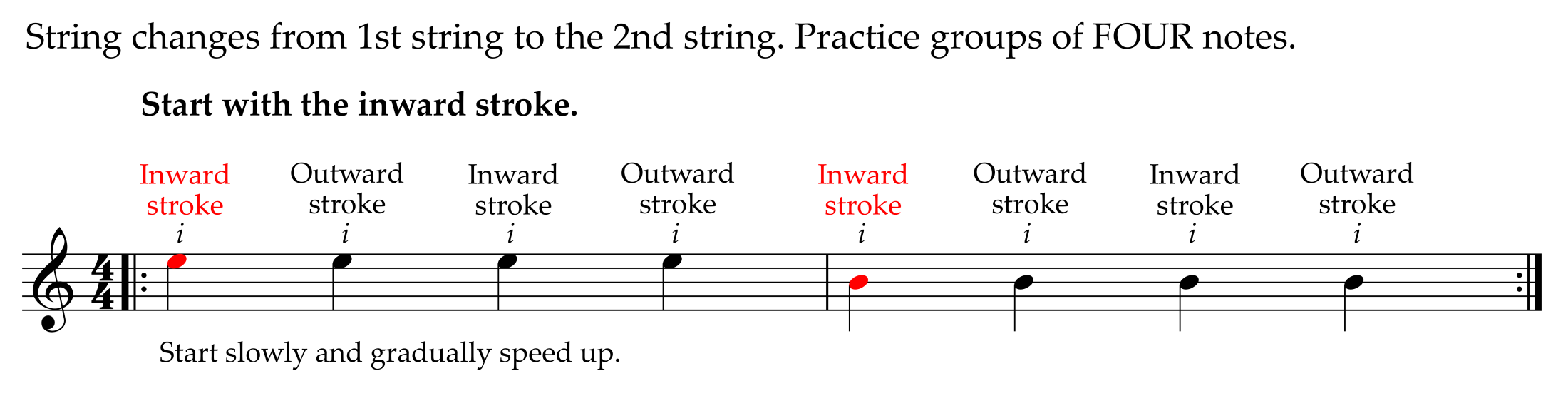
- Do the same but start each group of four with an outward stroke.
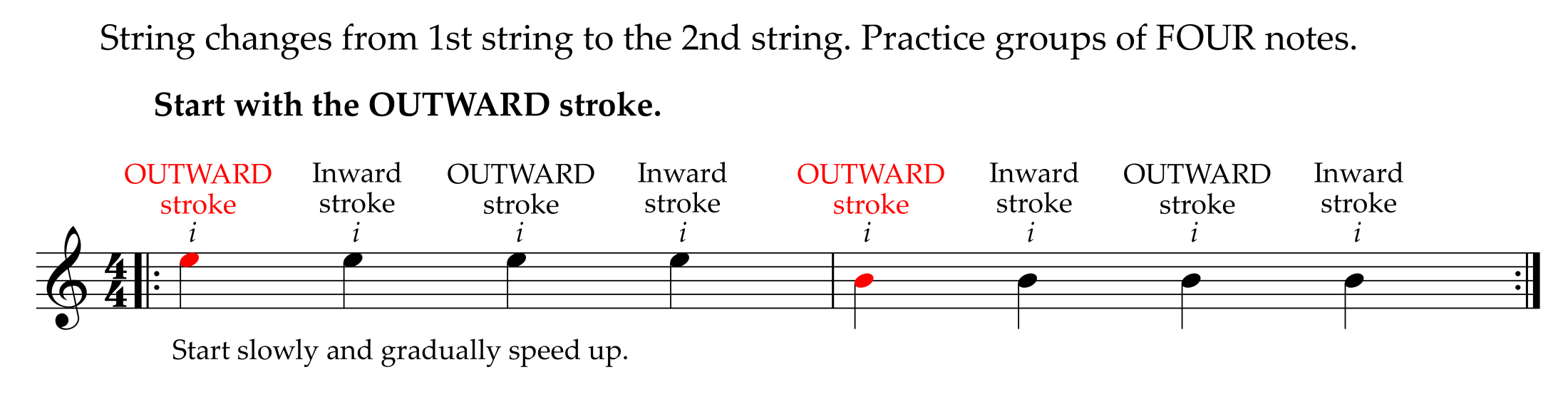
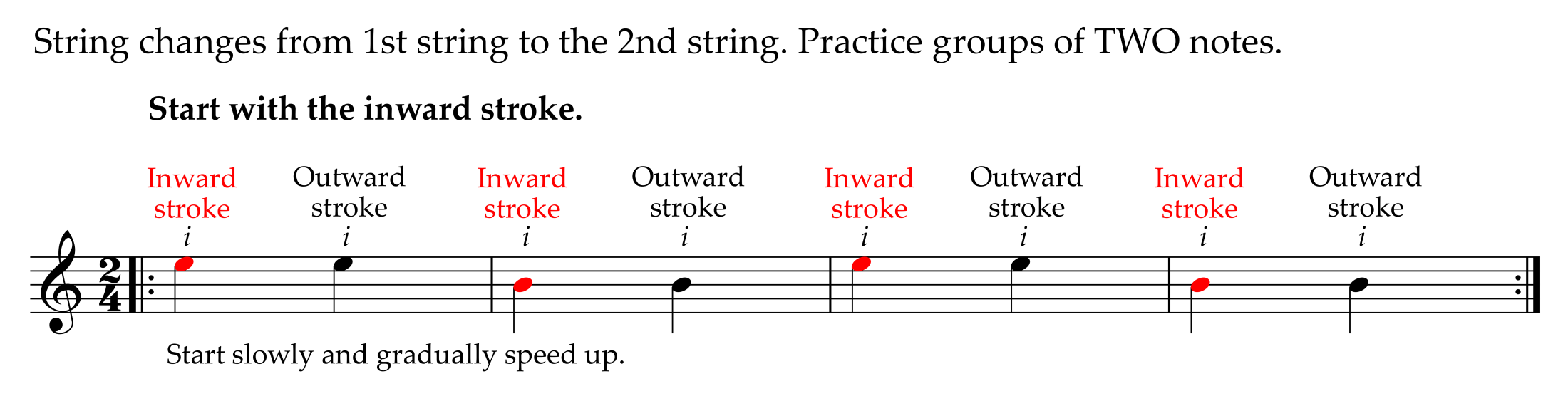
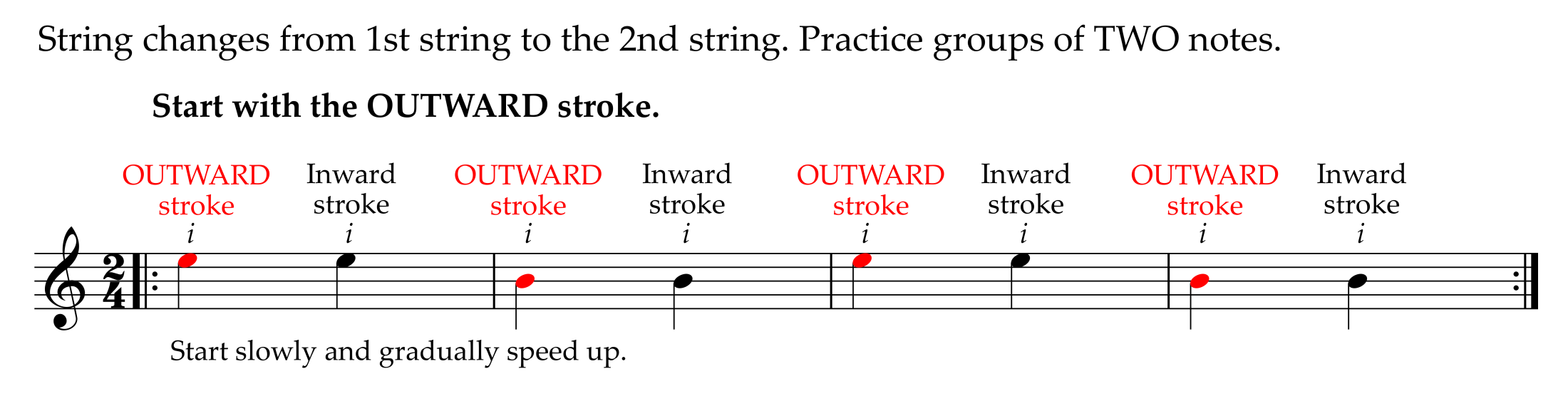
2. Practice groups of two notes
- Play two notes on the 1st string and then two notes on the 2nd string. Start each pair of notes with an inward stroke.
- Do the same but start each pair of notes with an outward stroke.
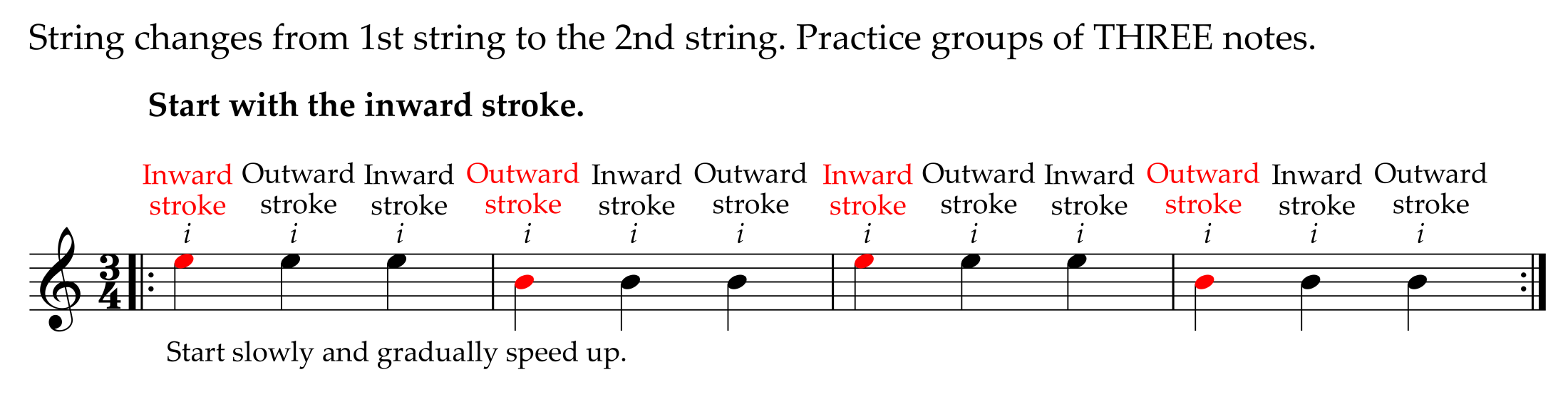
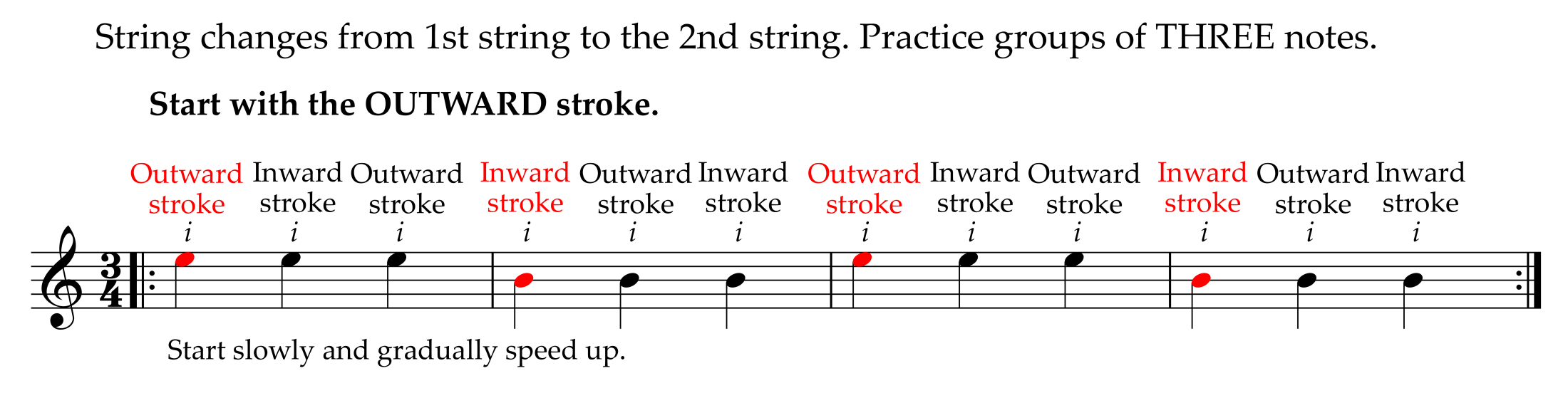
3. Practice groups of three notes
- Play three notes on the 1st string and then three notes on the 2nd string. Start the first group of three on the 1st string with an inward stroke. The second group of three on the 2nd string will start with an outward stroke.
- Do the same but start the first group of three on the 1st string with an outward stroke. The second group of three on the 2nd string will start with an inward stroke.
4. Repeat all of the above exercises but on the 2nd and 3rd strings.
Watch me demonstrate the practice routine on the 1st and 2nd strings.
Playing on the inner strings is difficult not only because of the string changes, but because it is hard to avoid accidentally hitting the adjacent higher-pitched string. If you find your are hitting the adjacent string, try leaning the hand back a little more if you are using the standard classical guitar position. If you are using a vihuela thumb-over or thumb-under position, try playing more laterally on the strings.
Dedillo in 20th and 21st -century classical guitar playing
To be clear, I do not advocate using dedillo for playing descending scales in general. Its best-use case is for playing transcriptions of vihuela music.
However, there are a few outlier cases where you will find it in modern repertoire. But its use in modern repertoire is different from that of the 16th century. For example, I’ve found no examples of its use for playing fast scales in the manner of 16th-century vihuelists, except in the pick-style form with the thumb locked against the index finger.
Watch the late flamenco guitarist Ben Woods demonstrate the pick-style dedillo (his dedillo demo starts at 1:30 and ends at 3:45):
Instead, in modern repertoire, guitarists use the dedillo technique as more of a mandolin-style tremolo on a single or multiple strings.
The dedillo technique in "Sakura"
For example, in the opening section of "Sakura Theme and Variations (on the Japanese folk song)" by Yuquijiro Yocoh, there are two measures of 32nd notes with the instruction "Tremolo with index finger." In this case, the composer uses the dedillo technique to imitate the koto. But, rather than a true vihuela-style dedillo of playing scales on single strings, Yocoh uses the technique to play two sustained strings simultaneously.
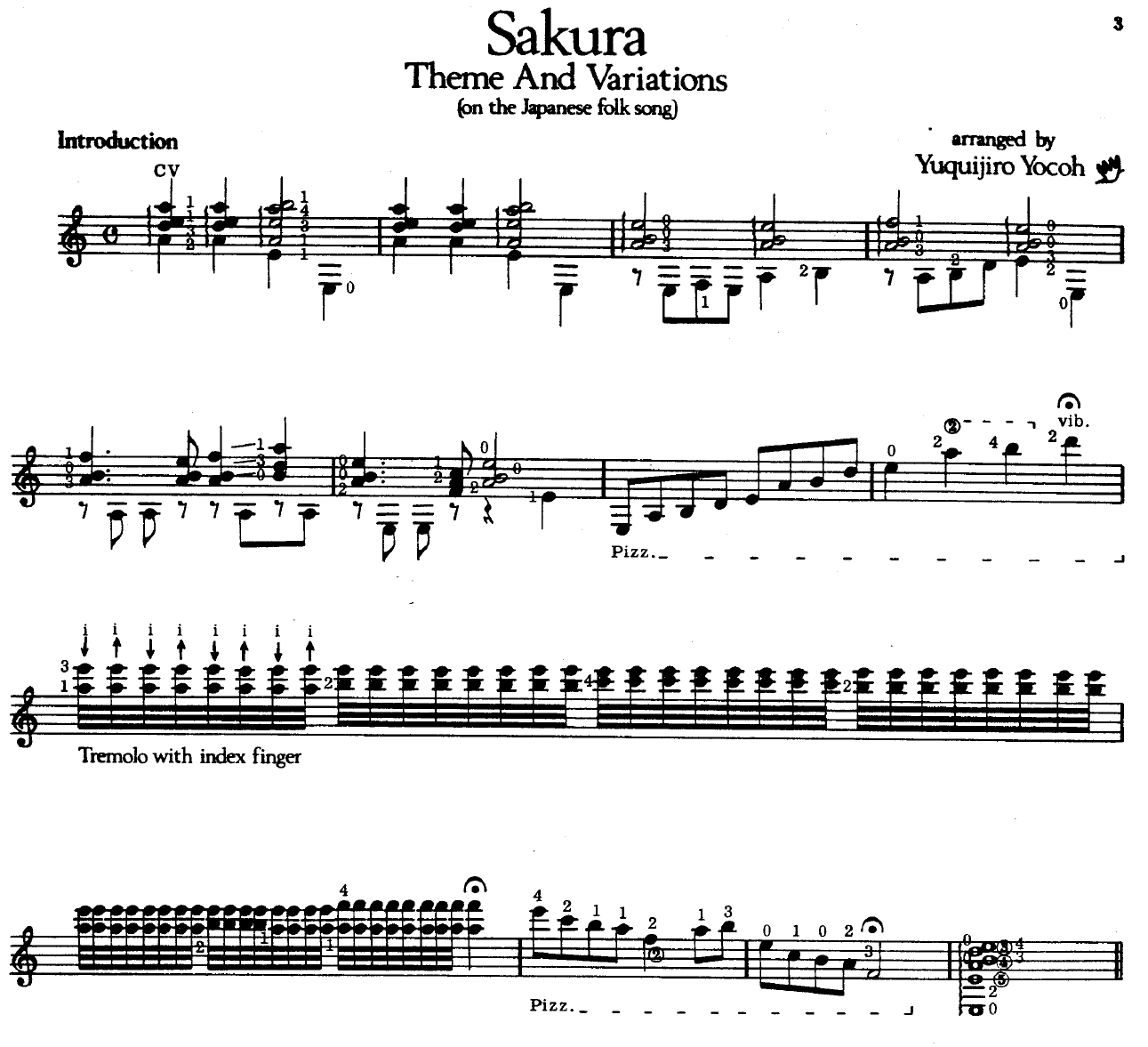
Watch guitarist Beatrix Kovács play the opening section of "Sakura". Note that she uses her "m" finger instead of "i" to play the tremolo (dedillo) effect.
The dedillo technique in Roland Dyens’ composition for guitar, "Libra Sonatine"
Towards the end of the first movement of his "Libra Sonatine," composer-guitarist Roland Dyens includes a a group of unmeasured intervals and chords. His performance instructions are "dedillo (aller-retour tres rapide avec le majeur) meaning "Dedillo (very fast back-and-forth motion with the middle finger)." Here again, the finger choice to play the dedillo is the middle finger rather than the vihuela-style index finger.
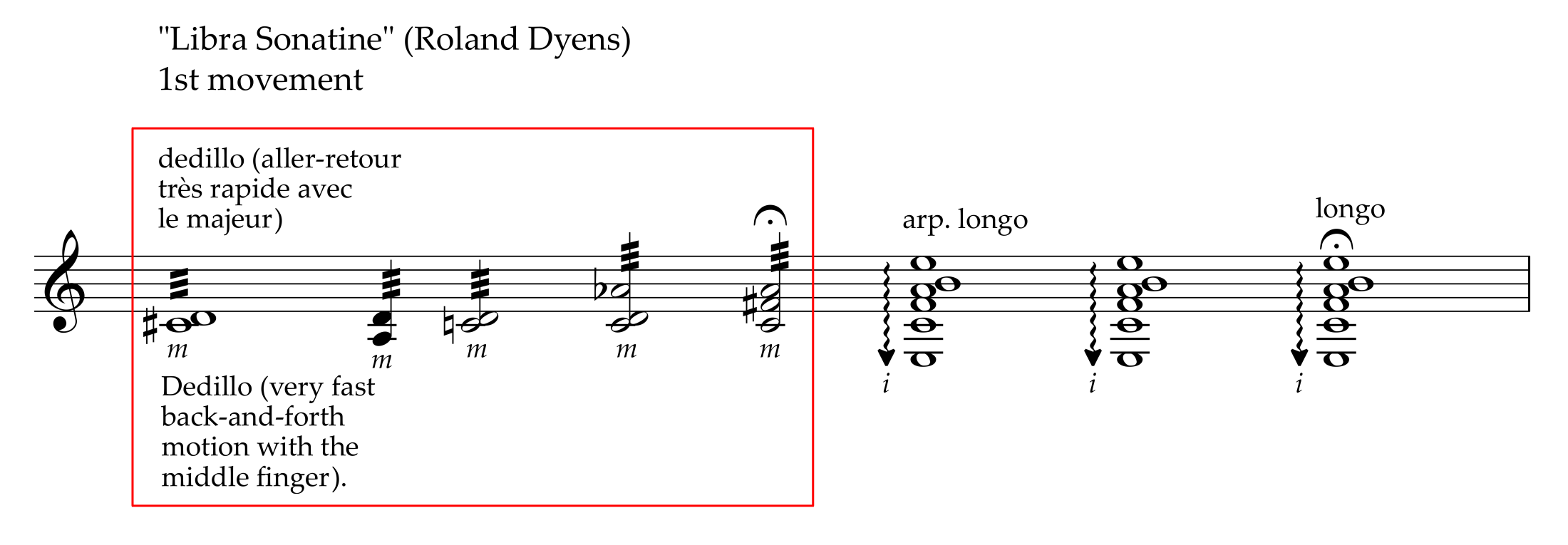
Listen to guitarist Juan Carlos Arancibia Navarro play the first movement. The dedillo passage starts at 3:58.
Dedillo in "Hommage a Bela Bartok byJana Obrovska
In her composition "Hommage a Bela Bartok," Jana Obrovska directs the guitarist to play dedillo with the thumb! The thumb dedillo was rarely used in vihuela music but is very effective here. Again, its use is for sustaining individual notes rather than playing scales.
Listen to guitarist Juan Carlos Arancibia Navarro play the first movement. The thumb dedillo passage starts at the 2:00 mark.
Dedillo in "Pictures at an Exhibition" by Modest Mussorgsky (transcribed for guitar by Kazuhito Yamashita)
In his transcription for guitar of the "Cum mortuis in lingua mortua" movement from Modest Mussorgsky's Pictures at an Exhibition, Yamashita directs the guitarist to tremolo the upper voice throughout. He alternates between using the "i" finger and and the right-hand pinky finger ("ch"). Once again, the dedillo is used to sustain single notes rather than play actual scalar passages.
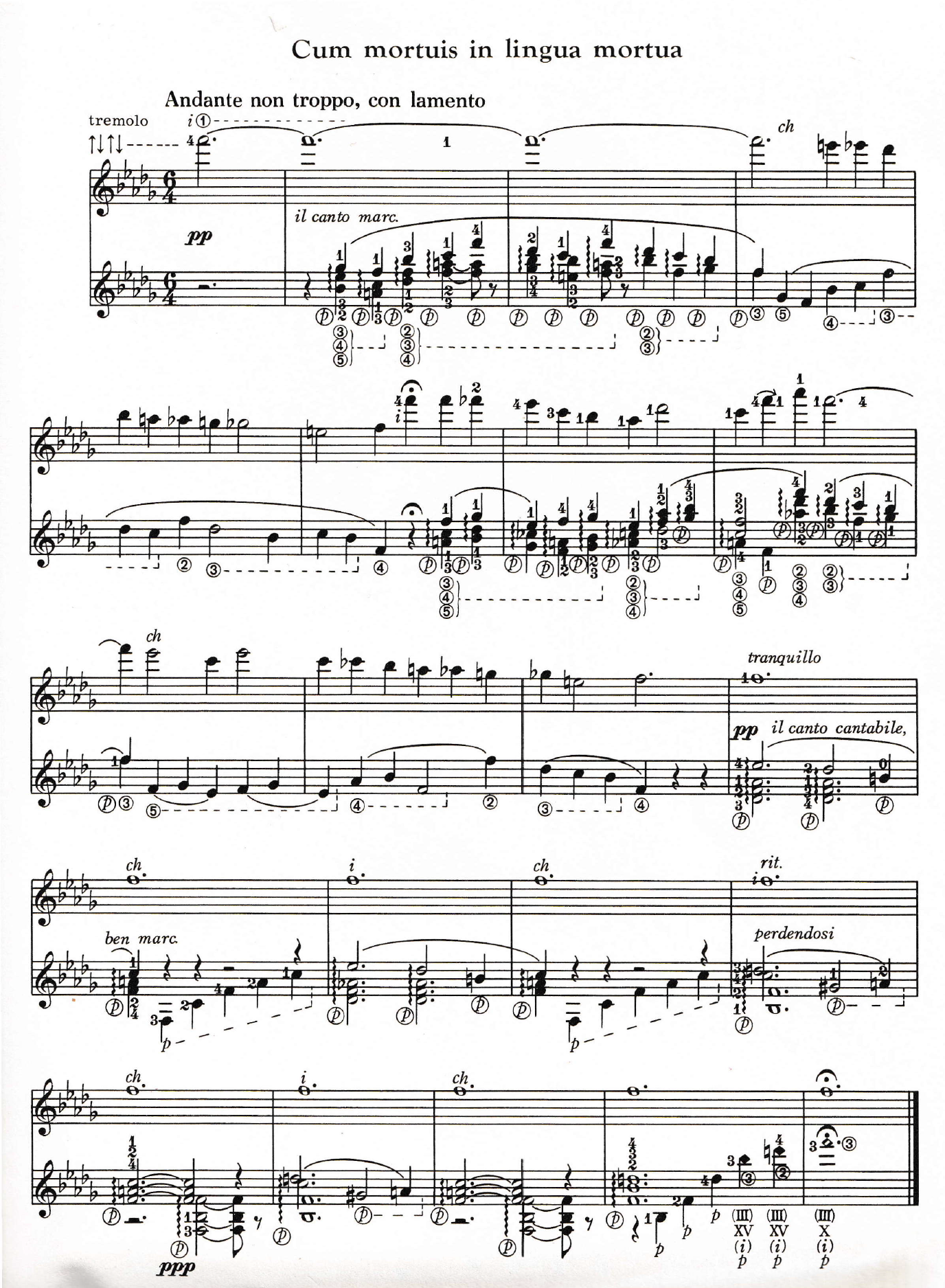
Watch Yamashita play the movement with dedillo tremolo. The movement starts at the 20:34 mark.
American guitarist William Foden and the mandolin-style dedillo tremolo
A guitarist you may never have heard of describes a plethora of tremolo techniques in his Grand Method for Guitar. William Foden (1860-1947), a native of my hometown, St. Louis, was known as one of the greatest guitarists of his age, especially among American players. He was known as the “wizard of the guitar” and famous for his brilliant technique. The capsule biography at the end of his guitar method says, “the outstanding feature of his playing was his unbelievable fast tremolo. Nothing like it had ever been heard before him. His technical agility and skill were extraordinary.” As a side note, he was also the teacher of Walter Fritschy who established the guitar program back in the early 1960’s at the Conservatory of Music and Dance, University of Missouri-Kansas City where I taught for thirty years and from which I am now retired.
Foden describes the tremolo as “a more or less rapid repetition of the same note or chord, and is performed on the guitar by various methods of right-hand fingering.” He describes one-finger, two-finger, three-finger, and four-finger tremolos. In his descriptions, the thumb is not counted as a finger. And the thumb may play a bass note before the first melody note as in conventional tremolos or simultaneously with the first melody note. To the best of my knowledge, several of these patterns are rarely used or heard today. Indeed, he tells us “The various styles of the tremolo for guitar, has never before been fully explained…” Let’s have a look.
William Foden’s One-Finger Mandolin-Style Tremolo (dedillo-like)
William Foden’s One-Finger Tremolo, Method #1
In his Grand Method for Guitar, William Foden (1860-1947) clearly describes a dedillo-like technique, which he calls the “regular one-finger style of tremolo.” He says it is exclusively a finger action, swinging the finger rapidly back and forth across the string with down and upstrokes. Foden says the action is done mainly from the “second joint” or middle joint. Note that he does not use it to play fast scales as the vihuelists did, but rather to produce a mandolin-style tremolo. Foden also played the mandolin, so no doubt this was his transference of the mandolin-style tremolo to the guitar.
He says the “m” finger is more frequently used but that a guitarist should be able to use the “i” finger just as easily. He says one should be able to change from one finger to the other “without the least inconvenience.” This is especially important he says, because a finger can become strained or tense when using this technique in an extended passage. When one finger becomes tired, switch to the other. He also changes fingers when the music changes from one string to another. Foden demonstrates the use of the one-finger tremolo in his "Melody" as shown here:
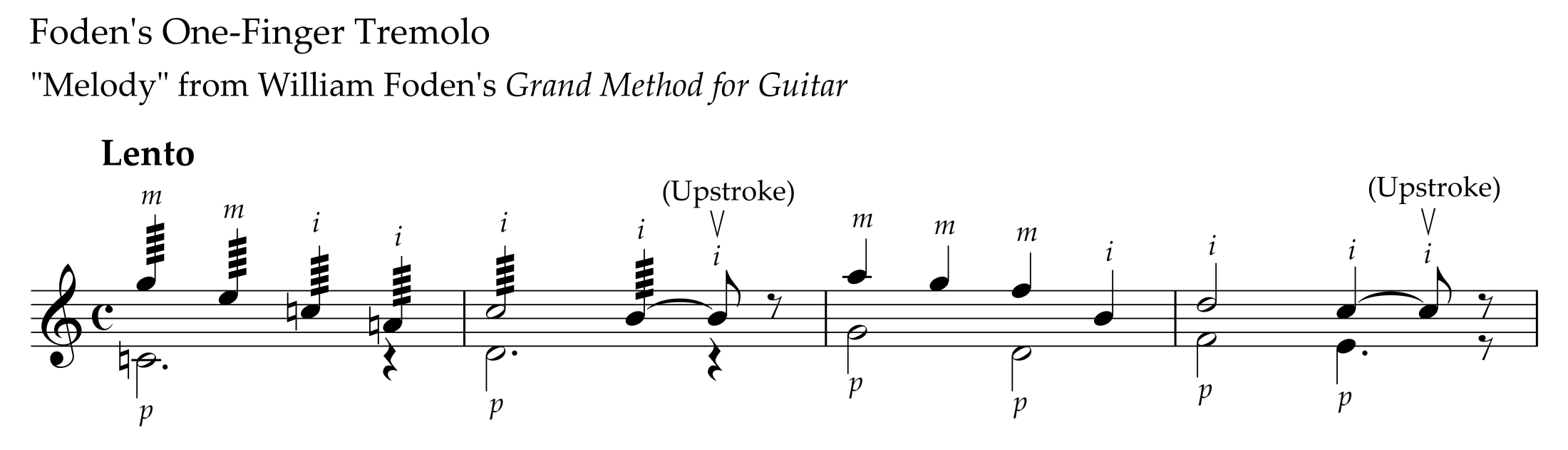
Note the shorthand method Foden uses to notate the rhythmic values of the tremolo. Here is Foden's shorthand notation to play tremolo 16th notes and then the actual notation of how to play it:
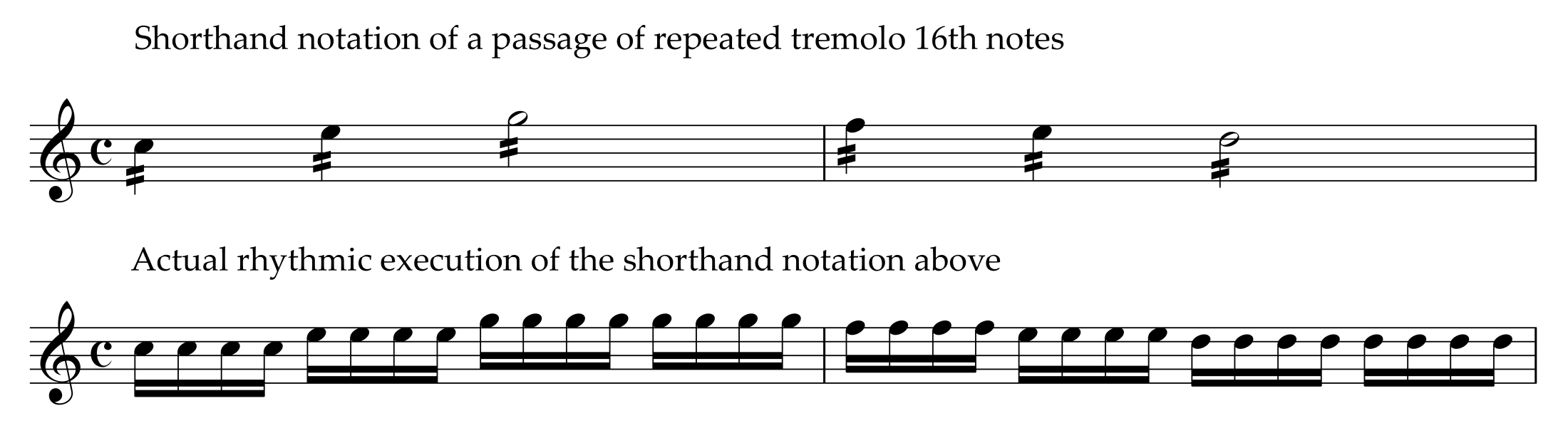
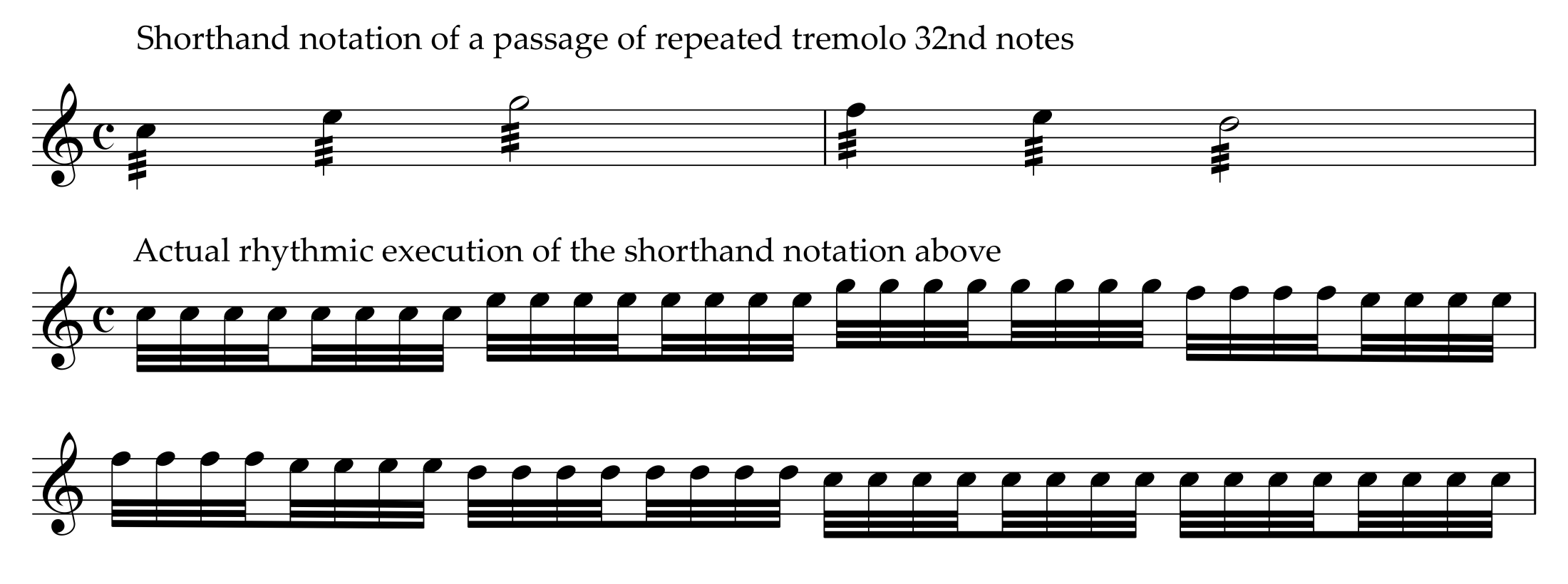
Next, here is Foden's shorthand notation to play tremolo 32nd notes and then the actual notation of how to play it:
Finally, here is Foden's shorthand notation to play tremolo 64th notes and then the actual notation of how to play it:
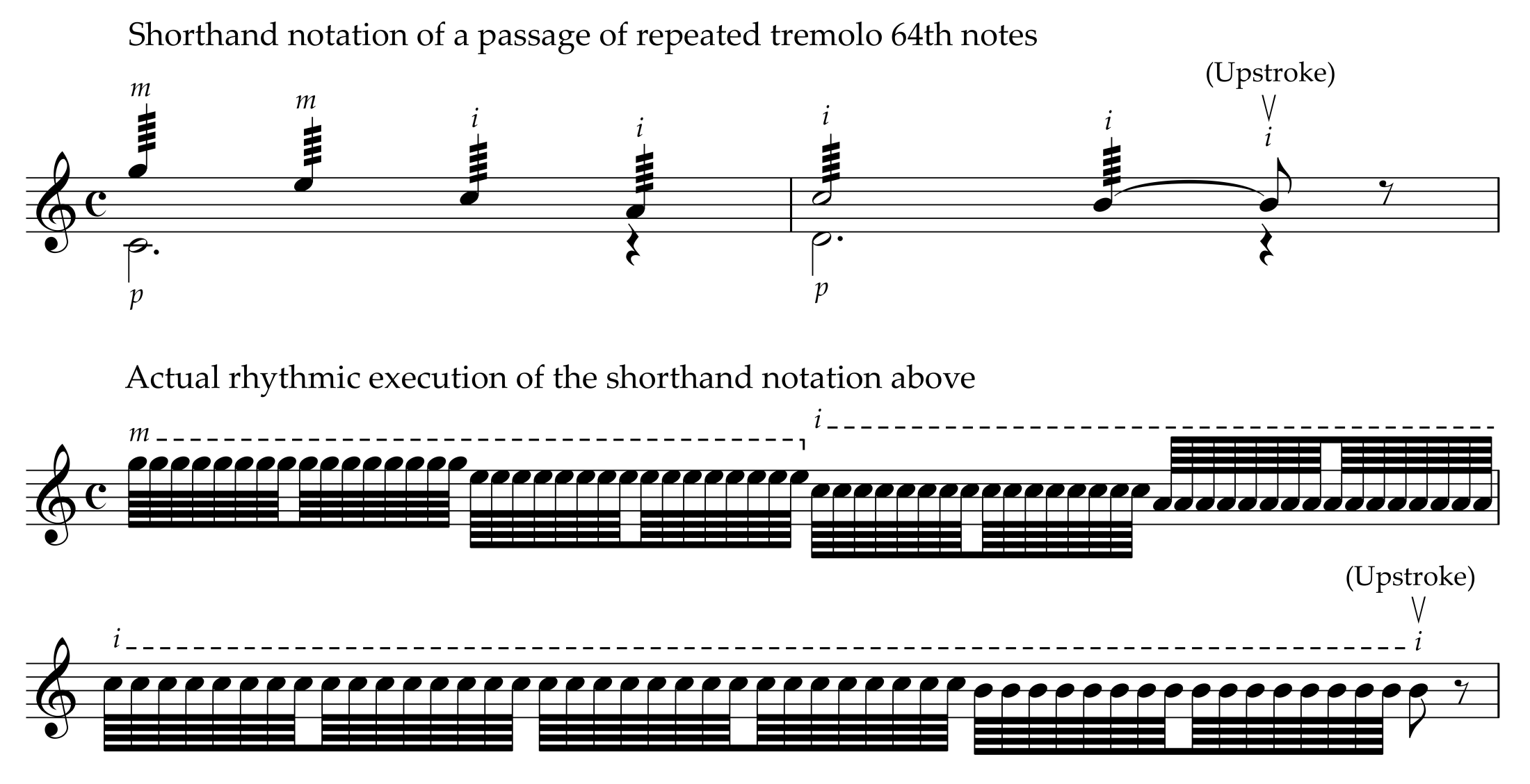
Depending on the style of the piece and tempo, sometimes it isn’t important to count a specific number of finger strokes. Foden says, “the tremolo must be executed rapidly; yet, in keeping with each particular style, and also with the character of the composition. The number of strokes to be played, are not always indicated; but if the time is accurately counted, the strokes will take care of themselves.” Again, this is clearly an imitation of the mandolin-style tremolo.
Interestingly, Foden uses the plectrum style (pick style) of notation to indicate the direction of the finger strokes in his introductory exercises for this technique. Always start with a normal stroke. In other words, you play the first string and follow through towards the second string. Foden indicates this with a “V”. Then, the finger restrikes the first string with the back of the fingernail. Foden indicates this with a “П”. Another way of thinking of it is that a normal free stroke with a finger is done in the same direction as an upstroke with a pick which is notated with a “V”. The finger stroke with the back of the fingernail is done in the same direction as a downstroke with a pick which is notated with a “П”.
Here is an example of Foden's plectrum or pick-style notation for the tremolo.

Foden used the dedillo tremolo technique not only for single notes but also intervals and chords.

William Foden’s One-Finger Tremolo, Method #2
Foden explains that the other form of the one-finger tremolo is to place the thumb across the tip segment of the index finger (as a support). Strike the strings down and up with the index finger using a loose wrist/ forearm rotation. In other words, use the index finger just like a pick.
The notation for the plectrum style of tremolo is identical to that of the regular one-finger tremolo. Foden states that his compositions always indicate the style by fingerings and/or the style name.
Notes about the thumb-in (thumb-under) and thumb-out (thumb-over) hand positions in lute and vihuela technique
In this article, I use the terms “thumb-under” and “thumb-in” interchangeably.
Likewise, I use the terms “thumb-over” and “thumb-out” interchangeably.
In discussing dedillo, we should look briefly into the right-hand position of lute players and vihuela players in the 16th century. We can categorize lute and vihuela right-hand techniques into three categories:
1. Plectrum
2. Thumb-under
3. Thumb-out
Plectrum (preferred method on the lute until around 1500)
In plectrum technique, the player holds the arm roughly parallel with the strings, a plectrum (pick) plucks the strings, and the motion comes from the wrist and forearm. Players of the time probably used a outward downstroke on strong beats and an inward upstroke on weak beats as players do today. Using a plectrum makes it relatively easy to play fast and loud. However, it is only useful for playing single lines or strumming chords. The player can’t play most polyphonic pieces.
Thumb-under or thumb-in (Preferred method on the lute from about 1500-1625)
-1036x1364.webp)
The thumb-under technique seems to have appeared in the late fifteenth century, probably evolving from plectrum technique. The player holds their arm almost parallel with the strings. Using a wrist/forearm movement, the player plucks a string with a downward stroke with the thumb for the strong beats and then alternates using an upstroke with the index finger for the weak beats. As the thumb and index fingers alternate, the thumb passes under the index finger, hence the term, “thumb-under”.
Advantages
1. The technique works very well for playing fast scales (also known as redobles, divisions, or diminutions).
2. It gives the player the ability to play polyphonic music.
3. The tone is very sweet or mellow because the player plucks the string at an extreme angle, which damps higher frequencies.
Thumb-over or thumb-out (Preferred method on the lute from about 1625-1800 when the lute becomes obsolete)
-2200x2903.png)
In the thumb-out technique, the position of the arm is more perpendicular to the strings instead of parallel (as in the thumb-under position). Players use a variety of angles, but if we play on adjacent strings, we consider the position as thumb-out if the thumb passes to the left of the index finger. Thumb-out is the best position for playing arpeggios, runs with bass notes, and polyphonic music.
Right-hand techniques on the vihuela
Based on the fact that the thumb-out technique did not become the preferred method of playing the lute until about 1625, we might think that all vihuela players used the thumb-under technique. However, there is reason to believe that vihuela players used the thumb-out technique in Spain before its adoption in the rest of Europe.
In the preface to his Libro de Cifra Nueva (1577), music publisher Venegas de Henestrosa describes four methods to play fast runs (also known as redobles, divisions, or diminutions) on the vihuela:
1. Play with the index finger of the right hand, which is called redoblar de dedillo [with the finger going back and forth across the string].
2. The Castilian style, in which the thumb crosses over the index finger. [Thumb-out]
3. The foreign style [figueta estranjera] which is the opposite, tucking the thumb into the hand, passing under the index finger. [Thumb-under]
4. Thumb out and play with the index and middle fingers.
Therefore, method #2 is the thumb-over technique and method #3 (the “foreign” style) is the thumb-under technique.
Since we usually think of the vihuela as a Spanish instrument, it seems that we could assume that vihuelists did NOT use the “foreign” style of thumb-under. However, images of vihuela players of the time show examples of them using both the thumb-under and thumb-over positions.
As William Bernard Hearn insightfully points out in his outstanding dissertation, Performing the Music of Alonso Mudarra: An Investigation into Performance Practice in the Music of the Vihuelistas, the geographical divisions of Spain in the 16th century were not what they are today. “Spain” did not exist as a country at all. There were two kingdoms, Castilla (Castile) and Aragon.

Venegas probably viewed the vihuela as an instrument common in both countries. Since Venegas lived in Castilla (Castile), when he referred to the “foreign” style of thumb-under, he was quite possibly referring to Aragon as a foreign country.
Vihuelist Luys Milán (1500-1561) lived in Valencia. Valencia was a province in the kingdom of Aragon, which from Venegas’ perspective would be a foreign country. Indeed, a woodcut in his Libro de música de vihuela de mano intitulado El Maestro (1536) shows a vihuela player using the thumb-under technique :
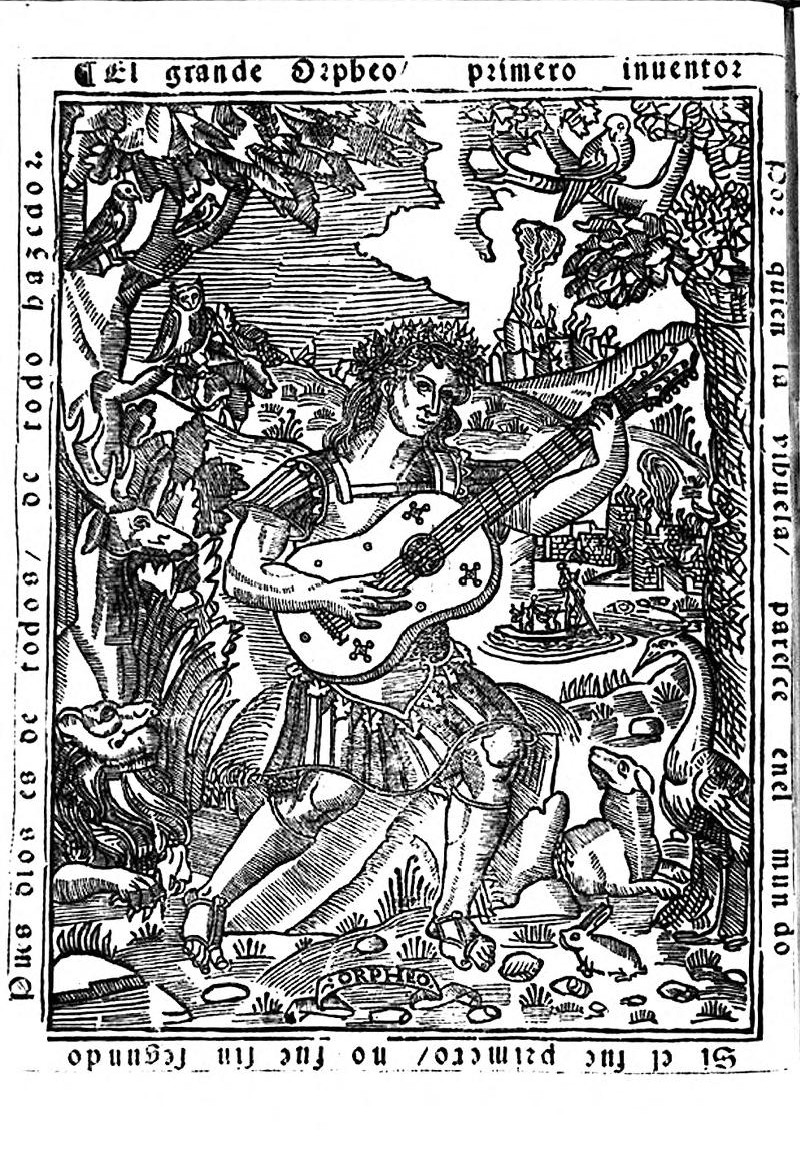
This confirms Venegas’ description of the thumb-under technique as being used in the foreign Aragonese Kingdom of Spain and other foreign countries of Europe.
On the other hand, Vihuelist Luys de Narváez (1500-1555) published his Los seys libros del Delphín, in 1538 in the city of Valladolid in Castilla (Castile). This image from the book clearly shows the vihuela player using the thumb-out position:
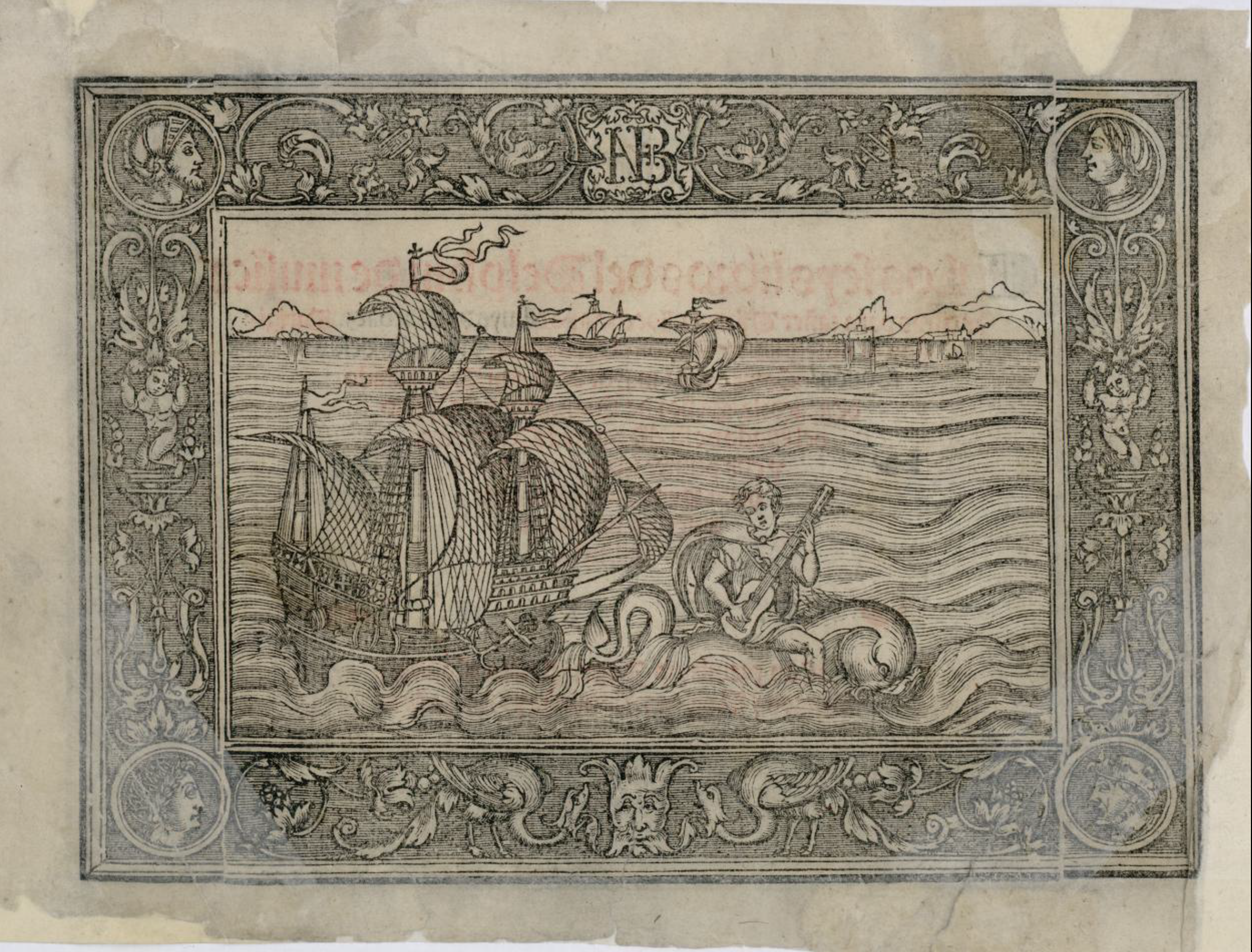
However, in Tres libros de música en cifras para vihuela (1546) by Alonso Mudarra (1510-1580), there is a crude woodcut, which, according to Hearn, clearly shows a thumb-under technique.” The player is playing the instrument left-handed and to me, it is really hard to tell what the hand position is. But if Hearn is correct, and as he himself acknowledges, it poses a contradiction. Mudarra lived in Castilla (Castile) and therefore, according to Venegas, should have used the thumb-over technique. But Hearn explains that Mudarra possibly traveled to Italy in 1529 and that Mudarra’s music contains “hints of Italian influence, including settings of Italian texts and instances of word painting.” He concludes, “Given these possible "foreign" influences. the inclusion of an illustration showing thumb-under is explainable and could be considered as evidence, if not complete proof, that Mudarra used this technique.”
To sum up which vihuelists used which technique, here is a handy table based upon Hearn's conclusions:
THUMB-UNDER (THUMB-IN) |
THUMB-OVER (THUMB-OUT) |
|---|---|
Luys Milán. Lived in Valencia (Aragon). Evidence: a woodcut in Libro de música de vihuela de mano intitulado El Maestro |
Luys de Narváez. Lived in Valladolid (Castile). Evidence: a woodcut in his Los seys libros del Delphín |
Alonso Mudarra. Although Mudarra lived in Seville (Castile), evidence favors putting him in the thumb-under category. (1) A woodcut from his Tres libros de música en cifras para vihuela shows the thumb-under position. (2) He had probable foreign influences (travel to Italy and he composed settings of Italian texts). |
Diego Pisador. Lived in Salamanca (Castile). Probable lack of significant foreign training or influence. |
Miguel de Fuenllana. Lived in Seville (Castile). Probable lack of significant foreign training or influence. |
|
Esteban Daza. Lived in Valladolid (Castile). Probable lack of significant foreign training or influence. |