Grace Notes: Understanding Musical Ornaments
and Their Significance
By Douglas Niedt
Copyright Douglas Niedt. All Rights Reserved.
This article may be reprinted, but please be considerate and give credit to Douglas Niedt.
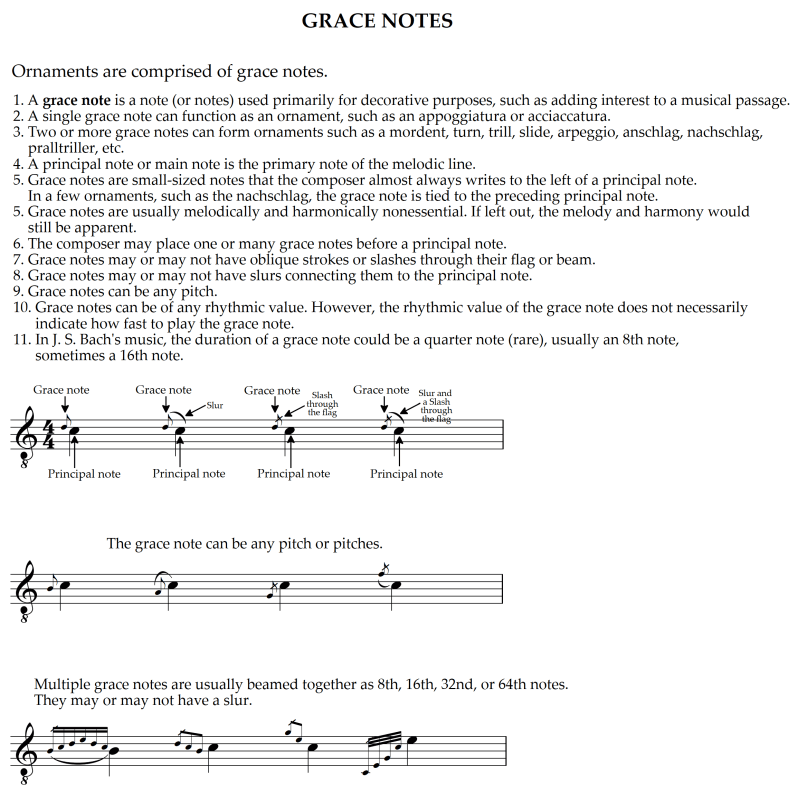
A grace note is a small-sized note used primarily for decoration, almost always written to the left of the principal note of the melody. A single grace note can form an ornament such as an appoggiatura or acciaccatura; two or more build ornaments such as the mordent, turn, trill, and slide. This page summarizes twelve key points about grace notes — slashes, slurs, pitch, rhythmic values, and their durations in J. S. Bach's music.
GRACE NOTES
- Ornaments are comprised of grace notes.
- A grace note is a note (or notes) used primarily for decorative purposes, such as adding interest to a musical passage.
- A single grace note can function as an ornament, such as an appoggiatura or acciaccatura. Two or more grace notes can form ornaments such as a mordent, turn, trill, slide, arpeggio, anschlag, nachschlag, pralltriller, etc.
- A principal note or main note is the primary note of the melodic line.
- Grace notes are small-sized notes that the composer almost always writes to the left of a principal note. In a few ornaments, such as the nachschlag, the grace note is tied to the preceding principal note.
- Grace notes are usually melodically and harmonically nonessential. If left out, the melody and harmony would still be apparent.
- The composer may place one or many grace notes before a principal note.
- Grace notes may or may not have oblique strokes or slashes through their flag or beam.
- Grace notes may or may not have slurs connecting them to the principal note.
- Grace notes can be any pitch.
- Grace notes can be of any rhythmic value. However, the rhythmic value of the grace note does not necessarily indicate how fast to play the grace note.
- In J. S. Bach's music, the duration of a grace note could be a quarter note (rare), usually an 8th note, sometimes a 16th note.