HOW TO LEARN A PIECE (SONG)
ON THE CLASSICAL GUITAR, Part 2
By Douglas Niedt
Copyright Douglas Niedt. All Rights Reserved.
This article may be reprinted, but please be considerate and give credit to Douglas Niedt.
*Estimated minimum time to read this article: 40 minutes.
MAKE A GAME PLAN FOR PRACTICING THE PIECE
Good practice habits are invaluable. They promote both deep learning and efficient use of your valuable time.
Teachers recommend:
-
Create a practice routine.
Try to practice in the same place at the same time for the same length of time, so it becomes part of your day.
Another point of view:
Yes, practice every day but mix it up now and then.- Changing the venue could be a breath of fresh air and make you more alert.
- You might hear things better in a different space.
- You might enjoy the new space and want to practice longer.
- By trying out various times of day, you might discover that even though you thought practicing in the afternoon was best, you may find that you focus better and your hands are more responsive in the morning or at night.
Wherever and whenever you practice, be sure you have all your essential tools available (music, metronome, a good chair, footstool, etc.).
-
Start every practice session with a clear goal or goals for what you want to accomplish and how you will go about achieving them.
For instance, determine what practice methods you will use and how much time you will spend on an item. Will you play it by memory? How fast will you play it, and will you practice with a metronome? Will you practice the right hand alone?
Another point of view:
Goals and clear focus are essential, but:- Having fun is also essential. Playing the guitar should be enjoyable. It doesn't always have to be a strict regimen. In Part 1, I quoted Steinway Artist, pianist, and educator Frank Huang. "In today's age, I believe that we, myself included, have been conditioned to be incredibly goal-oriented so that we feel rushed to complete a task as quickly and efficiently as possible." Although he goes on to say that learning a new piece takes discipline, there is something to be said for sitting down and PLAYING. Play for the sheer joy of it. So instead of focusing on measures 23 and 24 of Composition X, nothing is wrong with taking a little detour to spend time improvising, getting out the Django Reinhardt tune you love, or even singing a few songs.
- Then you can get back to your new song, and yes, make and achieve those goals.
- Playing through your piece from beginning to end is a step you will use LATE in the learning process after weeks or months of work.
If you are running through your piece every day or once a week, you will probably reinforce mistakes.
Pianist/pedagogue Graham Fitch recommends "resisting the temptation to end a practice session by playing the piece through, especially at a rapid tempo. Doing so can wipe out the benefits of careful practice in one fell swoop." Instead, play through other pieces you already mastered. -
Researchers have found that maintaining an awareness of one's level of concentration increases practice efficiency.
- As you practice, continually evaluate what you are doing. Ask yourself, "Why am I playing this right now, and what am I trying to accomplish?"
- Stop once in a while to assess your level of concentration. Don't just keep practicing until you (or those around you) can't take it anymore! If you're distracted and zoned out, you should probably take an honest-to-goodness break to recharge. If you tend to practice mindlessly, set your timer to go off every 5-10 minutes as a signal to practice something else or to take a break to keep yourself on track.
- After you finish practicing a problematic passage, stop for a moment and evaluate the quality of the practice you just completed. Be objective, not hypercritical. Make an honest, constructive self-critique. Don't scream, "I suck," and move on. Instead, examine whether your current practice strategy is working. If it isn't, try a different method. Or, give it a rest and move on to a new section. Makes notes in your music or practice journal on what you need to do next time.
Positively evaluating your progress will help maintain an attitude of optimism. You will see that difficult passages are learning opportunities. You will develop problem-solving skills to add to your tool belt to master any problem and proceed confidently, knowing that as you master each situation, you rise to a new level of competence.
- Keep a practice record or journal
Write your notes in a notebook, sheet of paper, or computer file. First, write down your goal for every practice session. Then, record what you practiced at the end of each session, what practice methods you used, and evaluate your success. Keeping these records will help monitor your progress and keep you focused.
Another point of view:
Journals are a colossal waste of time. You can better spend your time listening to the piece, practicing a little more, or studying the score. Instead, write important notes of what you practiced, metronome tempos, exercises, etc., directly in the music. But for neat freaks and the hyper-organized, a journal is a good idea. - Practice every day.
It is much better to practice 10 minutes each day rather than an hour once a week. Try to practice for a similar length of time every day to prevent injury or strain. For example, practicing 30 minutes daily during the week and five hours on Saturday and Sunday is not a good idea. When you exceed your physical limits, you risk injury.
Many musicians recommend doing several practice sessions each day to promote deep learning. Obviously, not everyone's schedule permits this, but if you can, give it a try. Other guitarists such as myself do not like splitting up the practice. Stopping and starting again is stressful on my muscles and, if the break is more than an hour, requires a thorough warmup each time I begin a new session.
If you decide you aren't getting enough done and want to increase your practice time, do it gradually, about 10-20% a week.
Another point of view:
Take a day off now and then or once a week to recharge and clear your mind. Many musicians find that when they take an occasional day off, they play much better the following day and get more done because they see the piece in a new light or fresh perspective. In addition, some find their hands feel rested and ready to tackle problems with renewed energy. - How long should you practice one piece in a practice session?
The experts tell us attention span fluctuates according to age, whether the person can perform the task fluently, how interested they are in completing the task, whether it's an old or new task, fatigue, stress, comfort of the environment, and many other factors. A standard estimate is that 20 minutes is about the maximum attention span for older children and adults, but it declines with age in some individuals.
Of course, that doesn't mean you should only practice the piece 20 minutes a day! Once your focus flags, you can restore it by resting, practicing a different spot, changing mental focus, or deliberately choosing to re-focus on the passage, all of which a musician does when they practice correctly.
Learning to focus in practice will lay the groundwork for you to focus under pressure during a performance. I use the word "performance" to mean anything from playing the piece from the beginning to the end for yourself to recording or videoing it, to playing it for your teacher, playing for a friend, to playing in a concert hall. If your mind wanders when you practice a two-measure chunk, it will be nearly impossible for you to concentrate for the time required to perform the entire piece. -
Take breaks.
Physical therapists and doctors recommend 25-30 minutes of activity followed by five minutes of rest. Breaks are good for you physically and mentally. Take a real break. Stand up, put your guitar in its stand, walk around the room/house or take a short walk outside, chat with family or a friend, etc. Then, pick up where you left off or start practicing a different passage or different piece.
I hate taking breaks because I get into a zone and want to keep going. If you have the same tendency, set a timer to make yourself stop. There are several phone apps called "interval timers" you can use. You can set the amount of time for the workout (practice) and the rest period. You can also choose the number of sets. For example, for a one-hour session, you could program it like this:
- Practice for 18 minutes"
- Rest for 3 minutes
- Practice for 18 minutes
- Rest for 3 minutes
- Practice for 18 minutes
- You're done. That is one hour. Now, you can rest for 10-15 minutes before starting a new one-hour session.
I have to admit that I'm usually grateful I stopped because the mental break helps get my mind clear for when I jump back in. Plus, it gives my hands and back a break as well.
If you are practicing something physically or mentally exhausting, take breaks more frequently. Sometimes, 10-15 minutes of practice followed by a 1-3 minute break works well. Learn even more why taking breaks is so important.
Guitarist Eric Henderson, when he was a young man, studied with the great Andrés Segovia. He describes Segovia's practice routine:"I would like to relate the words of the late Andrés Segovia, the greatest classical guitarist ever, who, if anyone, would be the authority on the best method of practice. This is what he taught me and told me was his method:
Do your practice in 15-minute sets. Divide each 15-minute set in half with a short 15-30 second break halfway through. At the end of each fifteen minutes, take a 3-minute break, stand up, get a glass of water, stretch, etc. but be sure to take a moment to focus your eyes on something far away to relax your eyes from the close work of the page and the fretboard and to clear your mind. Do three of these fifteen-minute sets, totaling 45 minutes of intense practice. Then, at the end of the third set, take a real break of about fifteen minutes. So, it looks like this:
- Practice for 15 minutes"
- Take a 3-minute break
- Practice for 15 minutes
- Take a 3-minute break
- Practice for 15 minutes
- Take a 15-minute break
Repeat this 3-set practice routine a total of five times. At that point, you will have practiced for around five and a half hours.
That is the morning session. Then, in the afternoon, you will do this entire routine again after having some lunch and a chance to rest. In the years I lived in Madrid, between 1971 and 1975, the traditional schedule for the day was to start between 8 and 9 am and have your main meal of the day around 2:00 pm; everything would shut down for this meal and a siesta that followed. Then, anywhere between 5:00 and 7:00 pm, everything would open back up, and the evening meal would not be until 9:00 or even 10:00 pm. So, I would eat the midday meal, take a siesta and then practice from 5 to 10 pm, before eating dinner, the lighter meal of the day."
Segovia used this routine and expected me, as his student, to do the same. Recently I heard somebody claim that he witnessed Segovia excusing himself after dinner, saying that he had to practice. Such was not the case in my experiences with him; he practiced in the mornings and the late afternoons and early evenings."
- Learn the notes first. Then work on interpretation.
Numerous teachers use this strategy with their students. The thinking is that there are too many things to think about when learning a new piece. For example, getting the right notes in the correct rhythm with the correct left and right-hand fingerings is a tremendous amount of information to absorb. They see adding such things as phrasing, dynamics, tone color changes, and articulation as "add-ons" after learning the basics.
Another (I think better) point of view:
The ultimate goal is to play our music expressively, artistically, and beautifully. The best way to be an expressive performer is to practice expressively. It isn't only about not making mistakes. EVERYTHING must sound good.
For instance, don't play repetitions as a series of perfect notes and nothing more. The idea is to implant musical habits, not mechanical habits, into your playing. Play the sections, chunks, or fragments with dynamics, shape them, play loud, play soft, bright, dark, staccato, legato, whatever the music requires. Produce the specific tone the music requires. If the passage is a beautiful melody, play it with a beautiful tone. If you intend contrast, practice it dark or bright.
Don't learn a passage and tell yourself, "Oh, I will add the dynamics, articulations, and tone colors later." Playing loud feels entirely different to the hands than playing quietly. Likewise, playing over the soundhole for a dark tone color feels entirely different to the hands than playing at the bridge for a bright tone. In effect, if you plan to add your dynamics and tone colors later, you will have to relearn the passage. Who wants to do that?
Let me make one thing clear before we proceed any further. There is no one way to practice or learn a piece, section, phrase, or musical fragment. Depending on one's abilities and the musical context, ONE MUST USE A MULTITUDE OF LEARNING/PRACTICE APPROACHES to master the passage.
THE MOST IMPORTANT RULE TO NEVER FORGET WHEN LEARNING A NEW PIECE: DON'T PRACTICE MISTAKES
One of the best books I have ever read about practicing is The Pianist's Problems, by William S. Newman. I quote and paraphrase from pages 124-127 of his excellent book.
Bad practice habits produce problems that can be almost impossible to fix. The adage, "practice makes permanent," is very accurate. We form habits alarmingly quickly. Therefore, we want to be sure we develop good habits, not bad ones. Many players begin working on pieces by doing run-throughs and sloppy, mistake-ridden repetitions. Unfortunately, the mistakes become habits, and the player must spend hours undoing them.
The guitarist who makes mistakes in their practice learns them whether they mean to or not. Often, the guitarist will chalk up an error to carelessness or call it an accident. But the learning process does not distinguish between accidents and conscious efforts. Fingers have no brain. Whatever habit they learn is what they will execute.
For instance, let's say you practice a passage ten times. If only four out of the ten repetitions were correct, you just taught the fingers to play the passage wrong. Whatever they do most frequently becomes learned neuromuscular coordination. Mistakes become learned and stick just as correct procedures do. Even when corrected, old mistakes have a demonic way of turning up at the worst possible times.
You must live by these words: "HESITATE, RATHER THAN ERR."
To prevent mistakes or "accidents," catch yourself before you make a mistake, just as you would if you found yourself about to walk off a cliff. Granted, catching yourself or anticipating an error in advance can be difficult. The guitarist who has fallen into the habit of making mistakes is usually the type whom the momentum of the rhythm leads around by the nose. Once on the verge of making a mistake, the rhythmic drive pushes the player over the edge, and he realizes the error too late. They might go back to correct the mistake once or twice, but as we shall see, doing so does little to counteract the learned muscular movement.
The solution to not making mistakes is to adopt this motto: "HESITATE, RATHER THAN ERR." Mistakes stick, but in time, one can easily bridge over hesitations of thought and action.
How do I learn to "hesitate, rather than err?"
Sit down with your husband, wife, significant other, son, daughter, best friend, or whomever. Explain that your goal is to play your piece (or a small section) from the beginning to the end without a mistake. Promise you will pay them $10 every time you make the slightest error and have to start over. I guarantee that as you get almost to the end several times and your "I Owe You" tab climbs rapidly, that your focus will become laser-like, and you will discover the meaning of "hesitate, rather than err" very quickly!
Listen to Your Brain: Practicing Mistakes Is the Worst Thing You Can Do
I'm going to repeat myself: Bad practice habits produce problems that can be almost impossible to fix. The adage, "practice makes permanent," is very accurate. We form habits alarmingly quickly. We want to be sure we develop good habits, not bad ones. Don't skip over this next section about neuroscience. If you understand how the brain learns new motor movements, you will see why it is so important not to practice mistakes.
The neuromuscular system includes all the muscles in the body and the nerves serving them. Every movement you make to play the guitar requires communication between the brain and the muscles. The nervous system links thoughts and actions by relaying messages from the brain to other parts of the body via networks of cells called neurons. Scientists estimate that the average male human brain contains about 86 billion neurons. Neurons, nerves, and muscles, working together as the neuromuscular system, make your fingers move when and where you want them to move when you're playing the guitar.
First, let's take a close-up view of two neurons. Example #8:
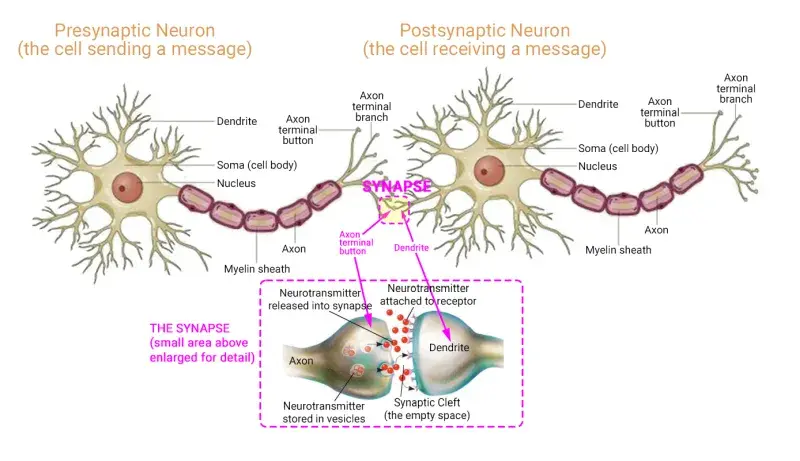
The neuron on the left is the presynaptic cell, the one sending a message. Its body is called the soma, and its center is the nucleus. The neuron has many spikey structures called dendrites extending out from the soma in all directions. The neuron on the right is the postsynaptic cell, the one receiving the message.
Let's follow the path of the message. Example #9:

If you follow the green arrow, you can see the presynaptic cell or neuron sending its message (in the form of an electrical charge) through its axon, the long, segmented arm extending from the right side of the cell. The message travels out through the little tentacles (terminal branches—there are thousands of them) to the axon terminal button, where it joins a dendrite belonging to the receiving postsynaptic cell or neuron on the right. The structure (highlighted in yellow) where the message transfers from the axon button to the dendrite of the receiving neuron is called the synapse. Each neuron is home to hundreds or even thousands of synapses. Current estimates are that we have 0.15 quadrillion (150,000,000,000,000) synapses.
You can see the synapse more clearly in the enlarged-for-detail purple box at the bottom of the diagram. Example #10:

The gap between two neurons is called the synaptic cleft. The gap is approximately 20-40 nanometers wide. If you consider that the thickness of a single sheet of paper is about 100,000 nanometers wide, you can start to understand just how small these functional contact points between neurons really are.
Let's focus on the synapse itself in the enlarged diagram. On the left, coming from the axon of the transmitting neuron, is the axon terminal button. Pouches called vesicles store neurotransmitters. There are hundreds of different neurotransmitters, but some of the more familiar ones are dopamine, serotonin, and norepinephrine. They are the red balls in the diagram. The presynaptic neuron initiates the release of the neurotransmitter from the vesicles. Then, the chemical diffuses into the synaptic cleft (the space between the neurons) to continue the process of transmitting the message.
The dendrites' job is to receive nerve impulses or signals (the message) from adjacent neurons. The dendrite of the receiving postsynaptic neuron has receptors that only bind with specific neurotransmitters (the chemicals floating around in the synaptic cleft). Therefore, receptors on the dendrites will only work when that specific neurotransmitter lands on them. Once a neurotransmitter matches up and binds with a receptor, the message has been received, and an electrical change occurs.
If it causes a positive charge, it excites the neuron, making it fire. The electrical charge carrying the message goes zipping down the axon of the second neuron (which now becomes the presynaptic neuron). Then the process repeats itself to pass the message onto the next target cell, the new postsynaptic neuron. When you play the guitar, cells, nerves, and muscles in your fingers or hands will receive the message to perform a specific action.
If the neurotransmitter causes a negative charge, it has an inhibitory effect, so the second neuron is less likely to fire. In that case, the impulse might not travel on to the next neuron.
One or two neurons can't do much by themselves. Activities such as playing the guitar depend on groups of neurons that work together. Neurons connect to other neurons, forming circuits that can process incoming messages and information and then carry out a response. When playing the guitar, numerous neuronal circuits work together to create complex neuronal pathways or networks from the brain to the spinal cord and muscles.
Let's say a guitarist is learning the famous Romance (Anonymous). There is a difficult chord change from measures 20-21. Example #11:

Below are simplified illustrations of three neural pathways our guitarist is using as he practices the chord change.
The first is Neuronal Pathway A. But it produces a buzz on the 1st-string C# at the 9th fret. So it is a bad pathway; it produces the wrong result. Example #12:

The second is Neuronal Pathway B. It produces a beautiful chord, clear with no buzzes. Example #13:

The third is Neuronal Pathway C. But it produces a buzz on the 2nd-string F# in the bar. So it is a bad pathway like A; it produces a bad result. Example #14:
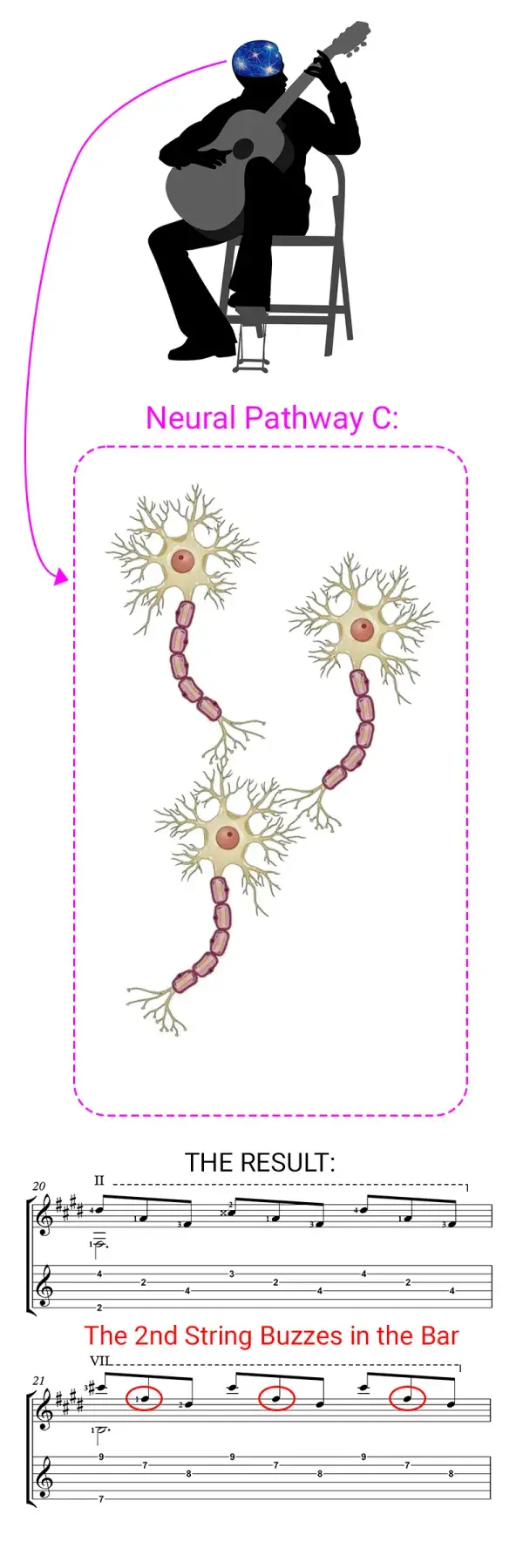
Now, if the guitarist does not stop to figure out why pathways A and C produce mistakes, he will continue using those pathways in addition to the good pathway B. So, for example, if the player does not realize that the 2nd string is buzzing in the bar because he is not keeping the rear joint of the finger raised to keep the bar flat, he is doomed to repeat the error. So he will continue to use that pathway.
So, here are the three neuronal pathways the guitarist is using as he practices the chord change. Example #15:

Pathway A is no good. It produces a buzz on the 1st string high C# at the 9th fret. Pathway B is the best. It makes a clear chord with no buzzes and no delay. Pathway C is another bad pathway because it produces a buzz in the bar on the 2nd-string F# at the 7th fret.
At this point, the brain does not prefer any one pathway. However, if the player repeats the passage ten times, he might use bad Pathway A two times, good Pathway B three times, and bad Pathway C five times.
Your brain is very smart. It notices which pathways get used. When you practice and don't use a bad pathway, the brain sees it as a waste of resources and dismantles it. But that only happens if you don't use it (in other words, if you don't practice the mistake). But if you use a bad pathway (practice mistakes) several times, the brain thinks it is important and keeps that pathway open and will use it repeatedly. What happens? You might play the passage a few times correctly, but mostly you will make lots of mistakes and buzzes because your neuromuscular system has now used the bad pathways several times.
But it's even worse than that. If you play a passage and make a mistake, even if you know you made the mistake and why, you still reinforced the pathway. You did it, and your brain thinks that pathway must still be important and retains it. You can scream all you want, "No, no. I didn't mean it! I don't want that pathway. Please, brain, ignore that mistake." But you used it, the brain doesn't know any better, and it reinforces the pathway.
Now what do you do? Are you doomed? Let's go back to the neuroscience and look "under the hood."
You will recall that the axon, the long segmented arm extending from the side of a neuron, carries an electrical charge (the message) to the synapse of another neuron. Example #16:

Axons are responsible for transmitting information over relatively long distances (often a meter or more). The axons send signals from one region of the nervous system to another, such as from your brain to your fingers when you play the guitar.
I explained above that when we don't use a neural pathway, the brain eventually gets rid of it. However, the brain also notices when we use a pathway a lot. There is a saying that "neurons that fire together wire together." When we learn something new and use deep practice, we form new neural pathways. Neurons are now firing together in a new sequence and thus are wiring together as a collective. Repeated firing of this neural pathway signals to the brain that the pathway is important.
Frequently used axons that comprise the frequently used pathway get covered with myelin, a fatty material that wraps around the axon to form the myelin sheath. Example #17:

Here is a detailed view of a smaller-diameter unmyelinated axon at the top and a larger-diameter myelinated axon at the bottom. Example #18:
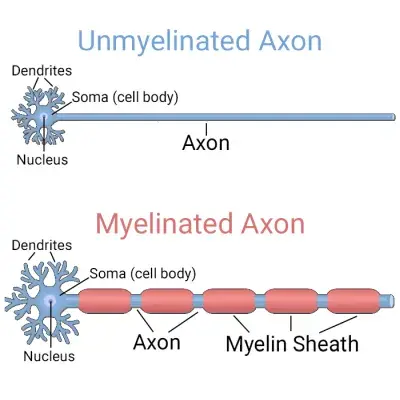
The myelin coating functions as insulation to minimize the dissipation of the electrical signal as it travels down the axon. Myelin also dramatically increases the speed of conduction of the electrical signal. Another way to think of it is that the neuromuscular pathway gets supercharged by the axons being wrapped in myelin. So the newly forged and repeatedly fired neural pathway is insulated like an electrical wire wrapped in a protective coating. Heavily myelinated neural pathways are optimized for speed and efficiency. They become the default behavior because the brain selects the most heavily myelinated pathway to perform an action. After all, it is clear to the brain that they are the most important. The behavior becomes automatic, a habit.
So here is the scary part. What if that supercharged pathway we made is the bad Pathway A or bad pathway C in our Romance chord change example above? Well, that is horrible news because you can't quickly dismantle a myelinated pathway. Myelin doesn't unwrap once it wraps, so you can't say, "Oh no, that's wrong. Unwrap that." You have to wait until the myelin breaks down (depending on how heavy the myelination is, it could take many weeks) and also have to be careful NEVER TO USE THAT PATHWAY AGAIN. The myelination process is why slow practice and "hesitate, rather than err" are so important. When you practice, you must guard against reinforcing the wrong pathway so that the brain does not wrap the axons with myelin. Do not reinforce the wrong hand and finger movements. When you practice, constantly ask yourself, "Which pathway am I myelinating right now? Which pathway am I strengthening? " If you continuously monitor that in your practice, your hands and fingers will not learn mistakes.
And remember, correcting a mistake after the fact accomplishes nothing. You already reinforced the wrong hand and finger movements. You myelinated the wrong path. Don't make the mistake in the first place. Play slowly and "hesitate, rather than err."
"Now I'm so scared I'll make a mistake I'm afraid to pick up my guitar. So what do I do now?"
An almost good practice strategy
As Molly Gebrian explains, a practice technique teachers commonly suggest to students is to practice an element ten times correctly, or seven times correctly, or three times correctly. It is almost good advice, but not quite. Here is what happens:
- The guitarist plays the problem spot. "Ah, that was good. I've got this."
- Second attempt. "That was excellent. I'm awesome."
- Third attempt. Their phone buzzes while they're playing the passage, and they get distracted. "Well, that wasn't very good. But it was the phone, so that doesn't count."
- Fourth attempt. The player is thinking about the text message they received and muffs the passage. "That was crummy. I was thinking about that text, so that doesn't really count."
- Things continue like that for the next several minutes where the guitarist plays the passage successfully a few times but also plays it badly several times. And somehow, the bad ones don't count!
At the end of the practice session, the guitarist has indeed played ten good repetitions. They have a pile of ten good neuromuscular pathways. That's just what the teacher asked for, right? Example #19:

But they also have a trash pile of many more bad neural pathways. Example #20:

The guitarist has accomplished (drum roll, please):
NOTHING!
Yes, the player played the passage ten times correctly, thus reinforcing that neural pathway. But they also played it wrong even more times. So the guitarist reinforced both pathways, the wrong one perhaps even more.
A better practice strategy: "The 10 Levels of Misery"
So, we need to make an adjustment. We need to use only the good pathway. We're still going to play the passage ten times perfectly. But the big adjustment is that the guitarist is going to play the passage perfectly ten times IN A ROW.
I have to admit that the "10 Levels of Misery" strategy is based on psychological warfare. It is unforgiving, inflexible, and utterly intolerant of any weaknesses in the guitarist's execution. But it works, and many musicians use it. The number of levels is the same as your goal—the number of times you want to play the passage perfectly. So, if your goal is to play the passage six times perfectly, the strategy becomes the "Six Levels of Misery." Here is how it works:
- First attempt. The guitarist plays the passage perfectly.
- Second attempt. The guitarist plays it perfectly again.
- Third attempt. The guitarist gets distracted by their cell phone. They mess up the passage.
- THE GUITARIST MUST START OVER. They must go back to zero. They don't get to say, "Oh, that didn't count." So now there is a consequence to not paying attention, not playing slowly, or not following our rule to "hesitate, rather than err."
- First attempt. Good.
- Second attempt. Good.
- Third attempt. Good.
- Fourth attempt. Good
- Fifth attempt. The guitarist doesn't focus on the right thing and makes a mistake. START OVER!
The strategy is merciless to players who are not concentrating. When the consequence is having to start over, the guitarist will focus much better and focus precisely on exactly what they must do to get it right. Or they will slow down dramatically. Or the phrase, "hesitate, rather than err," will finally sink in.
Kick it up a notch: add more misery!
In this variation of the strategy, if the goal is to play a passage six times perfectly and you get it wrong, not only must you go back to zero, but you must add a repetition to the total goal. So, if your goal is six times and you mess up, now you must play the passage seven times in a row perfectly. Then, after starting over, if you mess up again, you must go back to zero, and the new goal is eight times in a row.
When you use the practice technique, you must be sure to count the good repetitions. You can't do a bunch of good repetitions and assume, "Oh yeah, I think that was ten." I will guarantee you, that was not ten! Keeping track visually of your repetitions can be helpful. You can use coins or any small objects that fit on your music stand. The coins represent your repetitions. If your goal is six perfect repetitions, line up six coins on the left side of your music stand. Each time you play a passage perfectly, move a coin to the right side. If you have five coins on the right side (you played the passage five times in a row perfectly) but mess up the sixth attempt, move all the coins back to the left side and start over. For extra misery, as a penalty, add an additional coin. Example #21:

By the way, thanks to Leah Kruszewski for the coin idea and Philip Johnston (The Practice Revolution) for his term, "The 10 Levels of Misery."
As with many "novel" ideas, this is an old one. Wolfgang Mozart's father would place ten dried peas in his son’s left coat pocket, and for each successful attempt at a difficult passage, Mozart would move a single pea to his right pocket. When he failed on any piece, even if it was the tenth repetition, all the peas had to be placed back in his left pocket — Wolfgang had to begin anew.
Counting the number of good repetitions also has another purpose. It puts psychological pressure on you to get it right. If you have been at it for 20 minutes and you did level 9 (repetition 9) successfully, the pressure will be intense to play the 10th repetition perfectly so that you can move on to something else. It's like a basketball player getting ready to do a free throw or a soccer player making a penalty kick to win the game with one second left on the clock. It trains the guitarist to stay calm and maintain total concentration. This psychological pressure is what you feel when you play for someone. "Oh my gosh, I have to play it perfectly on the first try, right now."
A Caveat
The "X-times-in-a-row" or "X Levels of Misery" practice strategy works great for relatively small elements or a few measures. However, it would be quite daunting to use for long passages or sections. I will discuss how to practice those later.