By Douglas Niedt
Copyright Douglas Niedt. All Rights Reserved.
This article may be reprinted, but please be considerate and give credit to Douglas Niedt.
*Estimated minimum time to read this article, watch the videos, and understand the musical examples: 45-75 minutes.
NOTE: You can click the navigation links on the left (not visible on phones) to review specific topics or videos.
In music pedagogy, teachers have many approaches for learning a new piece: learning plans, learning maps, sequences of procedures, route maps, and methodologies. Many contradict each other.
I will explain several strategies, some traditional and others based on the latest neuroscience research on learning. I cannot say which methods will work for you, but all are certainly worth trying. Please keep an open mind and try them out for a few months before making a judgment.
We have many tools to learn a piece, and I will explain how and when to use them. We can use them to learn any song, whether easy or difficult. If you use the tools correctly, you will find yourself practicing with skill, efficiency, and effectiveness. You will notice significant progress. Success will make your practice satisfying and enjoyable.
PLEASE CHECK THIS OUT BEFORE READING! Below is a summary of this article. It will give you an easy-to-understand overview of the material before you dive in.
You will complete these four initial steps without the guitar in hand:
Learning a piece of music is a brain-intensive activity. Therefore, you must be alert and focused. A small thing that will smooth the way and eliminate distractions is to have the proper items immediately available in the area where you practice:
Have your teacher recommend a good edition or version of the piece you want to learn. Do not grab the first thing that shows up on an internet search. There are horrible editions of virtually any piece you want to learn. Many have wrong notes, terrible fingering, poor engraving, incorrectly-beamed notes, stems pointing the wrong direction, incorrect time signatures, misaligned notes, misaligned fingering and bar notations, bad layout, and on and on. Here is a frightening example of what you might find. I didn't make this up! This page is from the fast section of Prélude No. 1 by Heitor Villa-Lobos. Example #1:
Even in editions that don't have glaring errors and omissions, you will often find that editors notate the music very differently. Here are examples from eight editions of Lágrima by Francisco Tárrega. Notice the differences in the notation of the voices and note values. Example #2:
In the Etude No. 1 and Lágrima examples above, you can see how misleading shoddy editions can be. They can lead you astray before you even get started.
If you do not have a teacher to recommend an edition, try using an edition from a traditional publisher (Hal Leonard, Alfred, Mel Bay, Chanterelle), a reliable classical guitar website, or an edition by a prominent teacher or performing guitarist. Stay away from tab-only versions.
Even many otherwise reliable editions have poor fingerings. Fingerings can make or break a piece. Bad fingering will crack the foundation of learning with nearly fatal consequences to the music and the player's control of it. A disadvantageous choice of fingering causes inefficiency and outright failure in speed, power, and control. Inferior fingering can profoundly affect stage poise, technical mastery, speed of learning, and general security and confidence on the guitar. Read these articles for basic information on choosing good left-hand and right-hand (Parts I, II, and III) fingerings.
Some teachers recommend purchasing an edition with no fingerings so that the student can write in every fingering possible. This approach may work for an advanced player, but a beginning or intermediate player will not have the experience or knowledge to find all the possible fingerings.
Another approach I recommend is to purchase several editions of the piece and select the best fingerings among them. And, I must admit that occasionally I come across a fantastic fingering in a terrible edition by a clueless guitarist that works better than one by Segovia, Williams, Parkening, or one that I devised!
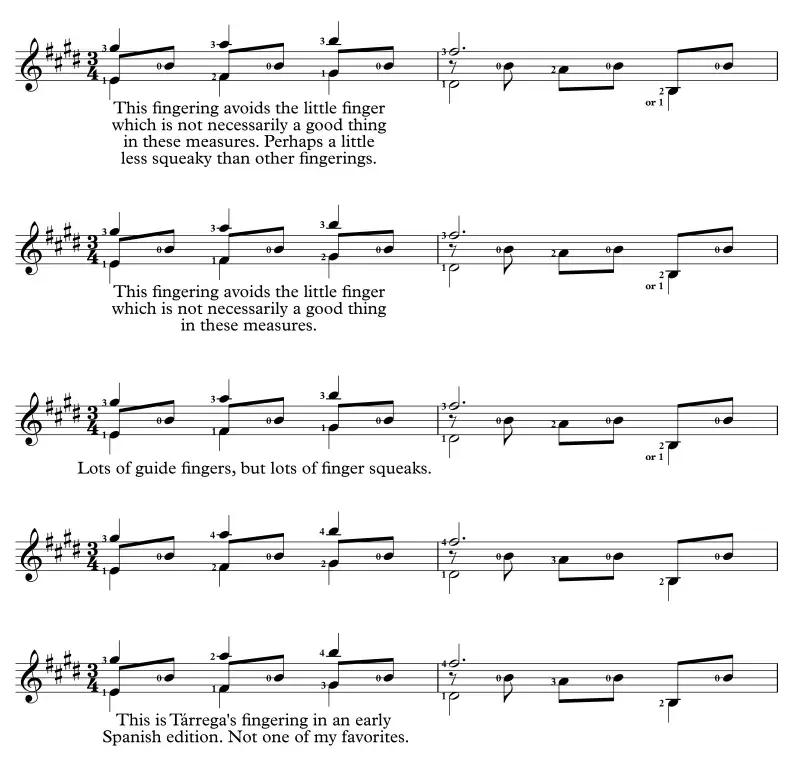
Here are several versions of fingerings of the first two measures from Lágrima by Francisco Tárrega. Example #3:
You can see the value of examining many editions of a piece to get ideas for the best fingerings to use. You don't blindly want to accept whatever fingerings one editor recommends. Their hands and guitar are probably different from yours. It is vital to choose fingerings that are best for you and bring out the best in the music.
I also watch numerous videos (sometimes 40-50 of a frequently performed piece) of various guitarists to discover new fingerings. If the camera stays focused on the guitarist's hands, it isn't too hard to "steal" fingerings off a video. I do the same with audio recordings. However, "stealing" fingerings off an audio recording is a more complex process. But if you have a keen ear, you can hear what string a note is on, where the shifts are, which notes get cut short or ring, where the slurs are, etc. Then, with a bit of deductive reasoning, you can be very successful at determining the fingering.
ALWAYS WRITE THE FINGERINGS IN THE MUSIC. Write in the fingerings (and any alternative second and third choice fingerings), bars, and string numbers neatly and close to the notes they concern. Write them in pencil because you may need to change them later. If you do not write them in, I guarantee you will forget some of them. Unfortunately, you will usually forget the most critical or complex fingerings. As you are learning a piece, you might spend an hour fingering one difficult spot. If you do not write in the fingering and then forget it two days later, you will have to spend another twenty minutes to an hour reconstructing it. Believe me, I know from hard-learned experience; that is a bummer! WRITE YOUR FINGERINGS IN THE MUSIC.
Whether video or audio, make your life easier by using a computer app to slow down the music and video without changing the pitch. My favorite is "Transcribe!" developed by guitarist Andy Robinson. It is inexpensive (a one-time purchase with forever free updates, no subscription) and full of features. Watch me demonstrate its features and how to use it in Video #1.
★ BE SURE TO WATCH ON FULL SCREEN. Click on the icon at the bottom on the right:
Get a feel for the big picture before starting to practice. Before you jump in and start learning your new song, it's essential to understand how the piece works as a whole.
Some teachers recommend sight-reading through the entire composition several times to get an overview. Hear the big picture. Other teachers say maybe it's okay to play it once, but not more than that. Why? Because a second or third read-through could form bad habits that will prevent the player from ever producing a finished, polished performance.
On the other hand, when the renowned piano virtuoso Vladimir Horowitz learned a new piece, he wouldn't only sight-read the new composition. Instead, he would make it a point to read through dozens of that composer's piano works to become acquainted with the composer's musical language and style.
Unless your sight-reading is very strong, I believe it is best not to risk ingraining mistakes. Instead of stumbling through the piece, I think you will get a better overview of how the music sounds by following the score as you listen multiple times to several professional players performing the piece.
Listening to the piece over and over will internalize the music into your body and brain. Japanese violinist and famed pedagogue Shinichi Suzuki realized the implications of the fact that children the world over learn to speak their native language with ease. Children learn words after hearing them spoken hundreds of times by others. He applied language acquisition principles to music learning and called his method the "mother-tongue approach."
Here is a striking example of this principle. Watch this three-year-old "conduct" the fourth movement of Beethoven's Symphony No. 5. Notice how sensitive he is to changes in the textures, tempos, rhythms, and melodies. And it is all from memory with no coaching or cues.
Watch Video #2.
★ BE SURE TO WATCH ON FULL SCREEN. Click on the icon at the bottom on the right:
As in language acquisition, listening to the piece you want to learn makes the learning process faster, natural, and more efficient.
Listen to lots of different recordings and follow along with your score. Listening with the score helps you get a clear "sound image" in your brain, making the notes on the page come to life. Strengthening the sound image by repeated listening forms a deep connection between the sounds in your head, where the notes are on the fretboard, and what they look like on the printed page. That connection will speed up the learning process. The notes are no longer an abstract entity on the page. The sound image will also make it easier for you to self-correct errors in reading because you will already know in detail how the piece should sound.
Philip Johnston, the author of The Practice Revolution, writes that recordings provide an alternative reference source when the reading challenge becomes too steep. The easiest way to make the most confusing written passage comprehensible, is to hear what you are looking at on the page. For example, when you come across a complex syncopated rhythm that may seem undecipherable on the printed page, listening to a recording tells you the correct way it should sound. Then, you can internalize what it sounds like and make the connection with the printed page in reverse. "Aha! So the rhythm that goes dum-dah-ah-da dum-dah-ah-da looks like that." Now you can more easily analyze and count it out, and the next time you see that rhythm, you will understand how it sounds.
In some cases, when trying to master a difficult passage, playing along with the professional can help untangle a problem. They may perform it blindingly fast, but if you slow down the passage with the "Transcribe!" software, you will be able to keep up with and learn from the master.
Some teachers say that listening to recordings tends to atrophy rather than nourish the imagination. But keep in mind that the goal is never to parrot back someone else's performance. On the contrary, when you hear multiple interpretations of the piece, you realize that everyone plays it differently. That realization sets your imagination free to help you make artistically informed decisions about tempo, dynamics, tone colors, phrasing, and much more so that you can find your own voice and play the piece your way. Also, if you ultimately want to play the music with passion and conviction, it helps to listen to someone playing the piece with passion and conviction.
Watch these three performances of Etude No. 1 by Heitor Villa-Lobos.
★ BE SURE TO WATCH ON FULL SCREEN. Click on the icon at the bottom on the right:
Do you hear how different they are? Did you notice that Tal Hurwitz does not play each measure twice as the other players do? Why? If you examined different editions of the piece as you are supposed to do, you would discover that Villa-Lobos did not include any repeats in his original handwritten copy. Did Villa-Lobos decide to add them later, or was that decision made by an editor at the publishing company? We don't know for sure. The point is that listening to many players and examining many editions opens up possibilities for you to approach the piece in your way.
You also might pick up some nifty fingerings you can use. For example, in the videos above, did you notice the flashy and very difficult passage from measures 24-25? Here it is, highlighted in yellow. Example #4:
Now, watch all three guitarists play the passage with different left-hand fingerings. The first guitarist, Xingye Li, uses a traditional fingering. Next, Tal Hurwitz uses a different fingering but still playing slurs on the descent. But Sanel Redžić takes a very original and entirely different approach with no slurs. It may not be what Villa-Lobos intended, but I admire the creativity and virtuosity.
Watch all three guitarists play the daunting passage from measures 24-25 in Etude No. 1 by Heitor Villa-Lobos. Watch Video #6.
★ BE SURE TO WATCH ON FULL SCREEN. Click on the icon at the bottom on the right:
Using the "Transcribe!" software I mentioned above, I figured out the fingerings. Here are the fingerings each guitarist uses. Example #5:
By watching these three guitarists play the Etude No. 1, we now have a choice of three excellent fingerings we can try out. But if we viewed more videos, we would discover even more fingerings such as these! Example #6:
Be sure you continue listening to recordings and studying the score throughout the learning process. Frequent listening will remind you of essential details, how each passage should sound, and the big picture. And sometimes, when you are knee-deep in bar chords, polyrhythms, and who knows what else, you can get discouraged, and the excitement of learning the piece can get lost. Listening again to the piece and hearing the promise of the beauty of the finished music will reinspire and energize you.
It will also allow you to compare what you are playing to what you hear and see in the professional examples. Often, as your familiarity with the piece increases, you realize that the professional performances are not uniformly good. You also might find you prefer your playing to that of some of the pros!
Steinway Artist, pianist, and educator Frank Huang writes:
I realize that this tip might stir controversy with my colleagues, but I strongly believe in this one. Let me explain. In the initial stage, when your music teacher assigns you a new work, you might listen to some recordings before you start learning the piece to get yourself familiar with it. I am okay with this, sort of.
However, I object to the notion of listening to recordings of the piece during the learning process. My reasoning is that this phase is supposed to be one of discovery and growth. What fingerings should I use in this tricky passage? What does this composer mean by this expression marking? How should I pace the melody here, and how many liberties can I take? To me, all of these types of questions are part of the exciting and creative journey.
When listening to recordings too early in this stage, one forms "prejudices" by trying to copy or emulate specific favorite recordings. The creative process suddenly disappears. One mentor reminded me a long time ago: "copied art holds far less value than its original." Only after we thoroughly sort out all of these fundamental issues can and should we listen to a wide range in styles and interpretations of the same work as a mode of comparison.
In today's age, I believe that we, myself included, have been conditioned to be incredibly goal-oriented so that we feel rushed to complete a task as quickly and efficiently as possible. I contend that the process of learning a new piece of music takes time, discipline, and patience.
If you agree with maestro Huang, another approach would be to apply the Horowitz sight-reading approach to video and audio. For example, if your new piece is by Fernando Sor, listen to or watch dozens of performances of Sor's other guitar works, not the new piece itself. Or perhaps you are learning a piece by a composer such as Villa-Lobos, who wrote works for the guitar but also for other instruments. In that case, listen to all his guitar compositions plus those he wrote for other instruments.
Another part of getting an overview of the composition is studying and analyzing the score to understand the piece's structure and all the markings on the page. If you have several editions of the piece, be sure to analyze every edition.
There are three approaches you can use for your analysis. You can use Choice C in addition to or instead of A and B.
Here is the checklist. As you find the items, be sure to make markings and notes in your music. Before you begin, make a few copies of the score to have clean copies for use in the next stages of learning.
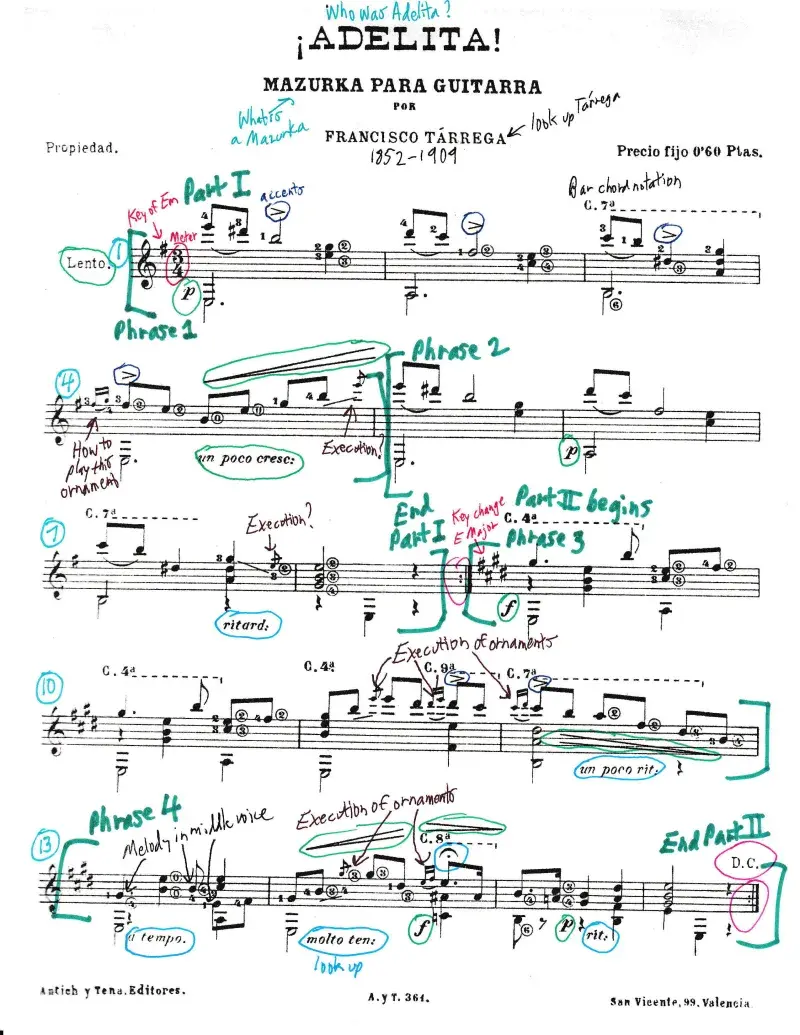
Here is an example of a preliminary score study and analysis I did of Adelita by Francisco Tárrega. Example #7:
I took note of everything for this example, which is why the page is crowded with notations. Usually, I would not have circled every accent, crescendo, decrescendo, tempo indication, and ornament. They are pretty obvious. But if you do a thorough job, the page will still look pretty busy. For that reason, again, make extra copies to have a clean score for the next stages of learning where you will write in fingerings, your own dynamics, articulations, notes you want to play rest stroke, tempo changes, etc.
If you find several editions of your piece, you will also want to compare the scores. Look for discrepancies in the notes, dynamics, articulations, tempo indications, EVERYTHING! It is a lot of work, but knowing you have choices and alternatives will prove invaluable as you begin playing your way through the piece.
Be prepared to spend a significant amount of time studying and analyzing the score. On a short piece, it may only take a few hours. However, on extended compositions, it can take weeks. Also, your score study is not a one-time event. It will continue throughout the learning process.